Showing posts with label climate change. Show all posts

Wednesday, 12 April 2023

The Carbon Offset Hoax


Carbon Offsets Explained to the Kiddies

(or "Pickle #4")

John Oliver presents a funny but true overview of "Carbon Offsets" here. As he points out, the whole thing is a hoax. But it's much worse than he says. It wouldn't work even if it were not a hoax.

Planting a tree takes C02 out of the atmosphere as it makes roots, barks and leaves out of the carbon it "breathes in". But this is a one-time thing. The "carbon offset" idea is based on the tonnage of vegetable matter created by the tree, not the entire life cycle of the tree. The Amazon forest emits more C02 than it absorbs on a net basis.

So, for example, the "trillion tree campaign", in theory, would offset a tremendous amount of carbon once. Next year, we'd need another trillion trees to be planted (or, absurdly, not cut down).

As John Oliver puts it, we can't offset our way out of climate change. Even if we could, the idea is fundamentally flawed. In the long run, planting or saving trees will have zero impact on climate change.

Monday, 20 March 2023

"Climate Change Denialist" Straw Man


The "straw man" fallacy intentionally creates a caricature of the opponent's argument to attack the caricature rather than the actual argument.

In the climate debate, those who question any element of the Utopian Activist agenda will be greeted by angry accusations of "denialism," accompanied by claims that "everyone" agrees with the "Science."

Just what "everyone" agrees to is not mentioned, but perhaps it refers to the fact that almost everyone agrees that the planet is warming, possibly due to human influence.

But the sceptic may be claiming that, for example, the alarm is not warranted, that there is scant evidence that particular disasters (such as hurricanes) are becoming more common, or that climate models are not fit for purpose. The sceptic will be shouted down as a "denialist," relieving the activist of any hard work involved in actually listening to the sceptic.

Other straw men available to activists include capitalism or any connection to the fossil fuel industry.

The fallacy can work the other way too. Climate activists tend to carry a lot of baggage that is not really connected to the core issue (fear that climate change will get out of control). A common bit of baggage is an unreasonable love of windmills. A sceptic can avoid discussing the real fears of the activist by shifting the discussion to windmills.

Saturday, 18 March 2023

Fallacies Rampant In The Climate Debate


Opinions are like assholes: everybody has one. It doesn't seem to matter how "expert" you are or how much you "respect the Science"; you will likely wallow in fallacy in any discussion. The Climate Issue is just a special case. The fact is, humans (even expert scientists) seldom think clearly or dispute fairly. To stand out, they need to be salesmen.

Confirmation Bias 

Confident that their field and expertise must be relevant to the debate, geologists are blind to evidence that it isn't. That's the main theory they seek to confirm. The second is looking for evidence within their "wheelhouse" to say something relevant. Magically, such evidence tends to bolster the economic interests of the industry that hires most of them, the fossil fuel industry.

Another fallacy to point out here is the assumption that the past tells us what the future will hold. This fallacy is popular with financial advisors and economists that always have an "explanation" of the past but systematically fail to predict the future.

The problem with all this is that the current situation is genuinely new. C02 levels are at the highest level in a million years. The concern is that this "must" affect the climate, especially surface temperatures that "must" have knock-on effects of all sorts. This bundle of ideas is another theory in search of confirmation, especially by the IPCC, which was expressly set up to confirm the theory. Magically, evidence is found if you interpret the evidence in a certain way.

We all love computers these days. Surely, computers can tell us the effect of all this C02. It turns out that they are not "fit for purpose." Computer models of climate have not, so far, produced convincing results. There are good reasons to suspect they will not do so for quite a while. There are good arguments that perhaps the task is impossible.

Yet, computer models are employed as if they are helpful. Those who are looking for useful insights coming out of the model magically see it. Interestingly the insights confirm what they think ought to be happening. I remember a debate with a friend over horoscopes. It was hard for her to grasp that the "stars" had nothing to do with human affairs. Daily horoscopes fed her an endless helping of confirmation bias. The spell was broken when she discovered that every horoscope seemed "kinda true," whatever she assumed about her birth date.

Very few participants in this debate are willing to consider the idea that computer models are useless, but those who do find more than enough evidence to prove their point. Experts on the subject who sell books that cast doubt on computer models find adequate evidence to support their view.

This is all "motivated reasoning," especially "reasoning" to persuade. The more people publicly adopt any position, claiming a special insight that others don't share, the more they stake their reputation in that position. That switches people into self-defense mode, attacking those who disagree (or merely ask questions or claim not to know). In that mode, nobody is thinking clearly. Confirmation bias is just one of the truckload of fallacies that are brought to bear once self-defense takes the place of reason.

The fallacy of Composition / Decomposition

Both sides use this. A big package of "evidence" is presented, such as Gore's famous movie and book or Wrightsone's "Inconvenient Facts." The fallacy is then employed like this:
  • I prove one or two of your bits of evidence wrong, so the whole argument must be wrong;
  • One or two of my arguments is right; therefore, the whole argument is right.
A serious student of the issue must examine each bit of "evidence" in its own right. How solid is it? Is it relevant? Special attention must be paid to scale, especially in the time dimension.

The fallacy of decomposition occurs when one accepts the general case (say that the climate is changing) and assumes that all the particulars (such as hurricanes becoming more frequent) are equally true. One you hear all the time is that "All Scientists agree that the climate is warming due to manmade influence"; therefore, all scientists agree that hurricanes are becoming more frequent.

The Genetic Fallacy

Used by the alarmist, this means that anybody associated with the oil and gas industry (such as all geologists) can be "canceled." No attention needs to be paid to anything they say since all their evidence is contaminated by where it comes from.

Used by the skeptic, this means that anything coming from Greta Thunburg is "Alarmist." Calm down, everyone. Nothing to see here.

Bad Math

Al Bartlett educates us on the math behind optimistic predictions about resource needs. What he says about coal applies to any mineral resource, including those required for the massive change from fossil fuels to a different mined resource, such as copper and lithium.

Bad math shows up in:
  • Failure to understand exponential growth;
  • Assuming that the "uphill" part of a resource-linked curve (such as C02 emissions) is exponential;
  • Failure to recognize that the "uphill" part of a curve is logarithmic, not exponential. This is true of C02 climate "forcing," for example;
  • "Coupling" failures, for example, not linking population models to resource availability curves, resulting in the illusion that per-capita resource use can follow population rather than availability of resources.
  • Failure to link any external model to the phenomenon of inflation. Rising prices are treated as an "independent variable" that can be dialed back by the right fiscal or monetary policy. Price signals coming from resource depletion or stresses on the "supply chain" are ignored.

Would You Buy A Used Car From a Politician?

Fallacy is the heart and soul of political rhetoric. It is tiresome to point out each one as if any other type of rhetoric would be possible in political debate. Yet I will attempt to point out a few especially rancid examples below. I have already commented on the flights of fancy coming from the IPCC. In this post, I want to zero in on how a few well-known politicians use fallacy to rouse the crowd in favour of their agenda.

Being Wrong


Everyone would be well served if people started asking why they are so damned sure of everything while many otherwise reasonable people disagree. Personally, I find myself to be wrong quite frequently. It turns out that people who disagree with me are not the only ones who are wrong but are absolutely sure they are right.

This is the classic book on the subject, which anyone who has ever been right or wrong needs to read.

(More later)

Wednesday, 15 March 2023

The Leap Manifesto

In the Canadian context, the Leap Manifesto is worth a detailed look.  The Manifesto should be seen as a continuation of the activist rhetoric of Namoi Kine and her husband, Avi Lewis (pictured). Both are well-known and respected figures in the activist world. Kline is frequently found commenting "out of her lane," as with her astonishingly ignorant comments on nuclear power.

Kline's "Manifesto" has much in common with the other famous one, the Communist Manifesto, another Utopian vision of a classless society purged of the profit motive. We have a pretty good idea of how that turned out. We should be wary of "manifestos." All of them seem to skip the nasty details of getting the public to go along with the dream, along with the troublesome problems of dealing with 
real problems without a magic wand.

The couple has presented us with their dream world, a Utopia (making them "Left Wing Utopians" on my political spectrum), along with some completely fanciful ways of getting there. Public response has been underwhelming but has not hurt the couple's careers as "influencers."


THE LEAP MANIFESTO

We start from the premise that Canada is facing the deepest crisis in recent memory:
[This is a bald and arrogant overstatement. The "crisis" is that almost nobody agrees with them. Not every problem is a crisis. In fact, not every "problem" is real at all.]
The Truth and Reconciliation Commission has acknowledged shocking details about the violence of Canada’s near past. Deepening poverty and inequality are a scar on the country’s present. And Canada’s record on climate change is a crime against humanity’s future.

[For those unfamiliar with Canadian politics, the Truth and Reconciliation Commission looking into some shameful aspects of Canada's past. How this became "the deepest crisis in recent memory" is a mystery.] 

These facts are all the more jarring because they depart so dramatically from our stated values: respect for Indigenous rights, internationalism, human rights, diversity, and environmental stewardship. Canada is not this place today— but it could be.

We could live in a country powered entirely by renewable energy, woven together by accessible public transit, in which the jobs and opportunities of this transition are designed to systematically eliminate racial and gender inequality. Caring for one another and caring for the planet could be the economy’s fastest growing sectors. Many more people could have higher wage jobs with fewer work hours, leaving us ample time to enjoy our loved ones and flourish in our communities. 

[Bald Utopianism.]

We know that the time for this great transition is short. Climate scientists have told us that this is the decade to take decisive action to prevent catastrophic global warming. That means small steps will no longer get us where we need to go.

[Here, we see genuine social issues tried to climate issues explicitly to make "Manifesto" action urgent. No time to think. No need to vote. No need to consider facts, costs, or priorities. The manifesto is now 8 years old. Did the crisis come and go while I slept?] 

SO WE NEED TO LEAP  

This leap must begin by respecting the inherent rights and title of the original caretakers of this land. Indigenous communities have been at the forefront of protecting rivers, coasts, forests and lands from out-of-control industrial activity. We can bolster this role, and reset our relationship, by fully implementing the United Nations Declaration on the Rights of Indigenous Peoples.

Small steps will no longer get us to where we need to go. So we need to leap”.

[As implied by the name "Manifesto," this is a call for revolution, which makes it "Utopian." One must say that the United Nations has come up with a lot of declarations. None has the force of law, as implied here. We can judge the effectiveness of such declarations by how the UN has managed its founding goal: World Peace. The UN deserves an article on its own, but I regard most of its "declarations," including those coming from the IPCC, as "Utopian." ] 

Moved by the treaties that form the legal basis of this country and bind us to share the land “for as long as the sun shines, the grass grows and the rivers flow,” we want energy sources that will last for time immemorial and never run out or poison the land. Technological breakthroughs have brought this dream within reach. The latest research shows it is feasible for Canada to get 100% of its electricity from renewable resources within two decades[1]; by 2050 we could have a 100% clean economy[2].

[The claim that we can get 100% of our electricity from renewable resources is blatantly false and misleading.  Does "getting ... electricity" means electrical generation? Even in that limited sense, does this mean we have the technology to create the baseline power generation and massive increase in infrastructure to support "renewables."] 

We demand that this shift begin now.

There is no longer an excuse for building new infrastructure projects that lock us into increased extraction decades into the future. The new iron law of energy development must be: if you wouldn’t want it in your backyard, then it doesn’t belong in anyone’s backyard. That applies equally to oil and gas pipelines; fracking in New Brunswick, Quebec and British Columbia; increased tanker traffic off our coasts; and to Canadian-owned mining projects the world over.The time for energy democracy has come: we believe not just in changes to our energy sources, but that wherever possible communities should collectively control these new energy systems.

[Hidden in this demand is the requirement that Canada stops exporting oil and gas. Balancing this would be a huge demand for foreign technology solar panels and wind farms. Nuclear (ruled out by Kline) is the only technology that can promise a reliable baseline power supply. Neither the issue nor the solution is mentioned. Note also that the Manifesto calls for shutting down Canadian ventures in other countries. The Manifesto is against mining. Presumably the lithium and copper required for renewable energy projects will magically appear without mining it.]

As an alternative to the profit-gouging of private companies and the remote bureaucracy of some centralized state ones, we can create innovative ownership structures: democratically run, paying living wages and keeping much-needed revenue in communities. And Indigenous Peoples should be first to receive public support for their own clean energy projects. So should communities currently dealing with heavy health impacts of polluting industrial activity. 
[The above is an explicit attack on the "capitalist" economic system. No alternative is proposed so we must assume a top-down command economy such as the one that failed in the Soviet Union. Or worse. Typically, the fact that the shares of large corporations are held directly by ordinary people or indirectly through their pension funds. This is, in fact, an "innovative structure" that is at the heart of the capitalist economy.]
Power generated this way will not merely light our homes but redistribute wealth, deepen our democracy, strengthen our economy and start to heal the wounds that date back to this country’s founding.

[We have heard this promise before: the "classless" society. These proposals will not "redistribute" wealth; they will destroy it, starting with the fossil fuel industry.]

A leap to a non-polluting economy creates countless openings for similar multiple “wins.” We want a universal program to build energy efficient homes, and retrofit existing housing, ensuring that the lowest income communities and neighbourhoods will benefit first and receive job training and opportunities that reduce poverty over the long term. We want training and other resources for workers in carbon-intensive jobs, ensuring they are fully able to take part in the clean energy economy. This transition should involve the democratic participation of workers themselves. High-speed rail powered by renewables and affordable public transit can unite every community in this country – in place of more cars, pipelines and exploding trains that endanger and divide us. 
[ "Renewables" require heavy mining, so they are not really renewable at all. High-speed rail requires massive amounts of a steel-a major source of greenhouse gasses.]
And since we know this leap is beginning late, we need to invest in our decaying public infrastructure so that it can withstand increasingly frequent extreme weather events. 
Moving to a far more localized and ecologically-based agricultural system would reduce reliance on fossil fuels, capture carbon in the soil, and absorb sudden shocks in the global supply – as well as produce healthier and more affordable food for everyone.

We call for an end to all trade deals that interfere with our attempts to rebuild local economies, regulate corporations and stop damaging extractive projects. Rebalancing the scales of justice, we should ensure immigration status and full protection for all workers. Recognizing Canada’s contributions to military conflicts and climate change — primary drivers of the global refugee crisis — we must welcome refugees and migrants seeking safety and a better life.

["Reform" of the food supply system is implied here,  which will imply a further hit to the economy since "capitalism" - return on investment - needs to be outlawed.]


Shifting to an economy in balance with the earth’s limits also means expanding the sectors of our economy that are already low carbon: caregiving, teaching, social work, the arts and public-interest media. Following on Quebec’s lead, a national childcare program is long past due. All this work, much of it performed by women, is the glue that builds humane, resilient communities – and we will need our communities to be as strong as possible in the face of the rocky future we have already locked in.

Since so much of the labour of caretaking – whether of people or the planet – is currently unpaid, we call for a vigorous debate about the introduction of a universal basic annual income. Pioneered in Manitoba in the 1970’s, this sturdy safety net could help ensure that no one is forced to take work that threatens their children’s tomorrow, just to feed those children today.

We declare that “austerity” – which has systematically attacked low-carbon sectors like education and healthcare, while starving public transit and forcing reckless energy privatizations – is a fossilized form of thinking that has become a threat to life on earth.How we can pay for all of this? Read “We Can Afford The Leap” by Bruce Campbell, Seth Klein, and Marc Lee

The money we need to pay for this great transformation is available — we just need the right policies to release it. Like an end to fossil fuel subsidies. Financial transaction taxes. Increased resource royalties. Higher income taxes on corporations and wealthy people. A progressive carbon tax. Cuts to military spending. All of these are based on a simple “polluter pays” principle and hold enormous promise.

[I'd love to see the math here. They demand not just the elimination of the fossil fuel subsidies industry but the elimination of that industry. There is an implied attack on all forms of "capitalist" contribution to the economy. How does that magically fund the socialist agenda?]

One thing is clear: public scarcity in times of unprecedented private wealth is a manufactured crisis, designed to extinguish our dreams before they have a chance to be born.

Those dreams go well beyond this document. “We call on all those seeking political office to seize this opportunity and embrace the urgent need for transformation”. We call for town hall meetings across the country where residents can gather to democratically define what a genuine leap to the next economy means in their communities.

Inevitably, this bottom-up revival will lead to a renewal of democracy at every level of government, working swiftly towards a system in which every vote counts and corporate money is removed from political campaigns.

[Experience shows (see below) that these ideas utterly fail as a "bottom-up" renewal of democracy. They are non-starters in the real world of democracy. Therefore, I see them as anti-democratic, as revolutions tend to be.] 

This is a great deal to take on all at once, but such are the times in which we live.

[NO KIDDING!] 

The drop in oil prices has temporarily relieved the pressure to dig up fossil fuels as rapidly as high-risk technologies will allow. This pause in frenetic expansion should not be viewed as a crisis, but as a gift.It has given us a rare moment to look at what we have become – and decide to change.

And so we call on all those seeking political office to seize this opportunity and embrace the urgent need for transformation. This is our sacred duty to those this country harmed in the past, to those suffering needlessly in the present, and to all who have a right to a bright and safe future.

[Gotta say  "sacred duty" explicitly makes this a pseudo-religious campaign. Don't expect logic to interfere.]

Now is the time for boldness.

now is the time to leap


Here is the Wikipedia entry on "LEAP," which delves into Canadian politics' impact.

In reality, NDP leader Tom Mulcair distanced the party from the manifesto and instead ran a moderate, "pragmatic" campaign that included promises to balance the budget and effectively perpetuate austerity.[15][16]

As it turned out, that campaign was a disaster for the NDP.

Then [NDP] premier Rachel Notley and president of the Alberta Federation of Labour Gill McGowan were vocal opponents, citing the centrality of the oil industry to Alberta's economy—and the industry's desire for new pipelines—as reasons to reject the manifesto.[5]

Gutting the Alberta economy would not be popular with Alberta voters. This raises the key problem with the "Manifesto." Like manifestos before it, policies would be rammed down the throats of ordinary people. Whatever its merits, The Manifesto could not be implemented in a democratic country. Notley's attempt to moderate the anti-capitalist tone failed. She lost the next provincial election to the far right. The dispute continues, with Alberta challenging the right of the Federal Government to cripple the economy of a province to meet climate change goals.

Bernie Sanders in the United States and Jeremy Corbyn in the United Kingdom, but the NDP, under new leader Jagmeet Singh, again distanced itself from the manifesto.[29]

No further detail is needed. The Manifesto is dead in the water as a serious proposal. It is chiefly of interest as a fossil remnant of a Utopian dream.

--------------------------------------------------------------

PS --- Here is a presentation that depicts the explosive need for mining to meet the "energy transition." 

Tuesday, 14 March 2023

The Making of Many Books


Anyone who is anyone has written a book on climate change. There are a dozen in my library. On the subject of climate change and books, there seem to be three groups:

(1) I have not personally read anything, but I know what the Science says" or doesn't say;

(2) I have read a book, so I know what Science says or doesn't say. You only know what you are talking about if you have read this particular book and ignore anything else you may have read.

(3) I have read x books (lots), so I know what Science says or doesn't say. Even if you have read an equal number of books, they are all biased (if you disagree) or totally right (if you agree);

The point is nobody's mind will be changed by piling up books or saying, "read this book." We are all preaching to the choir.

Since it's actually quite important to "change minds" (maybe even your own), and since throwing books at each other is futile, what's the alternative?

First, we must build respect for each other and encourage the "other" to respect their ability to judge the matter. In many cases, an individual will frankly opt out of the discussion, saying the issue is too "polarized," there are "arguments on both sides," etc. This is effectively a neutral position and, in some cases, the best you can do.  But many climate activists have this attitude, supporting political agendas that make radical assumptions on climate. This is true on both "sides," with the "left" inheriting climate panic and the "right" claiming climate change is a socialist hoax. Understanding this is an improvement over the idea that the "polarization" is over the facts of the issue rather than the proposed actions (or inaction). It is possible to come to a position on climate that is independent of your political views*. It is very common for people on the "left" side of the political spectrum to dismiss skeptical evidence as suspect simply because it is coming from the political right.

If we can show the individual respect for his/her judgment, we can encourage curiosity, not to read another book "on our side," but to read a neutral assessment that's independent of the IPCC talking points. "What We Know About Climate Change" is a good choice since it is firmly in the IPCC orbit and written by an actual scientist. But the strategy is not to read another book. It's to read the book yourself and encourage people to take an interest in the core issues.

The more you listen to others, the more they gain confidence in their ability to understand things. Based on that, the next step is to investigate whatever issues come up between you. Form a little study group. Recognize that forming your own ideas (rather than cloning others) takes work. New ideas need to be grasped. Even the most cursory investigation into the issue will be rewarded by a substantial ability to understand statistical concepts (climate change itself is a statistical concept). Sadly, lack of statistical education, let alone the ability to spot lies told with statistics, is the rule rather than the exception. For such individuals, it may be useful to dig down into the political influences brought to bear on the IPCC "summary for policymakers." The top-level claims of the IPCC and the press vastly overstate the importance of "peer-reviewed" articles and the mythical "97% of Scientists" that agree with something to do with climate change. Very few people know the "sausage making" that goes into the policy summaries.

Examine the political agenda that attaches itself to both "sides." On the far left, the urgency of the climate crisis is borrowed to create urgency for a swath of far-left social programs. On the far right, doubt is sewn over the entire discipline of climate science by those paid specifically to defend industries that are under threat from any climate action. Those who grasp the concept of "Big Green" along with "Big Oil" come a long way to seeing the dispute in a new light. Everyone is cashing in on this.

That may be the best you can do. Promote an ongoing discussion of all related issues, from basic science to politics. For better or worse, in a democracy, our personal opinion counts. Without room for respectful disagreement, we lose our ability to support specific actions we all support (perhaps for different reasons.) That is the magic of democracy.

---------------------
* I vote "left," but I'm a climate emergency skeptic. To me, the proposed action on the climate "emergency" will disproportionately hurt the poor by pulling funds away from actual social issues to the "Big Green" agenda. To me, poverty, not climate, is the emergency. Since the climate issue is already a bit of a "side issue," I am free to examine the issue without the political baggage that is carried by many of the people I contact. I still could not do that if I didn't feel that left-wing activists were not outright lying to the public about the "emergency." I recognize Science Fiction when I see it.

THIS POST MAY BE A GOOD PLACE TO LIST THE BOOKS I HAVE ACTUALLY READ ON THE SUBJECT, NOT PARTICULARLY IN ORDER NOR NECESSARILY COMPLETE:

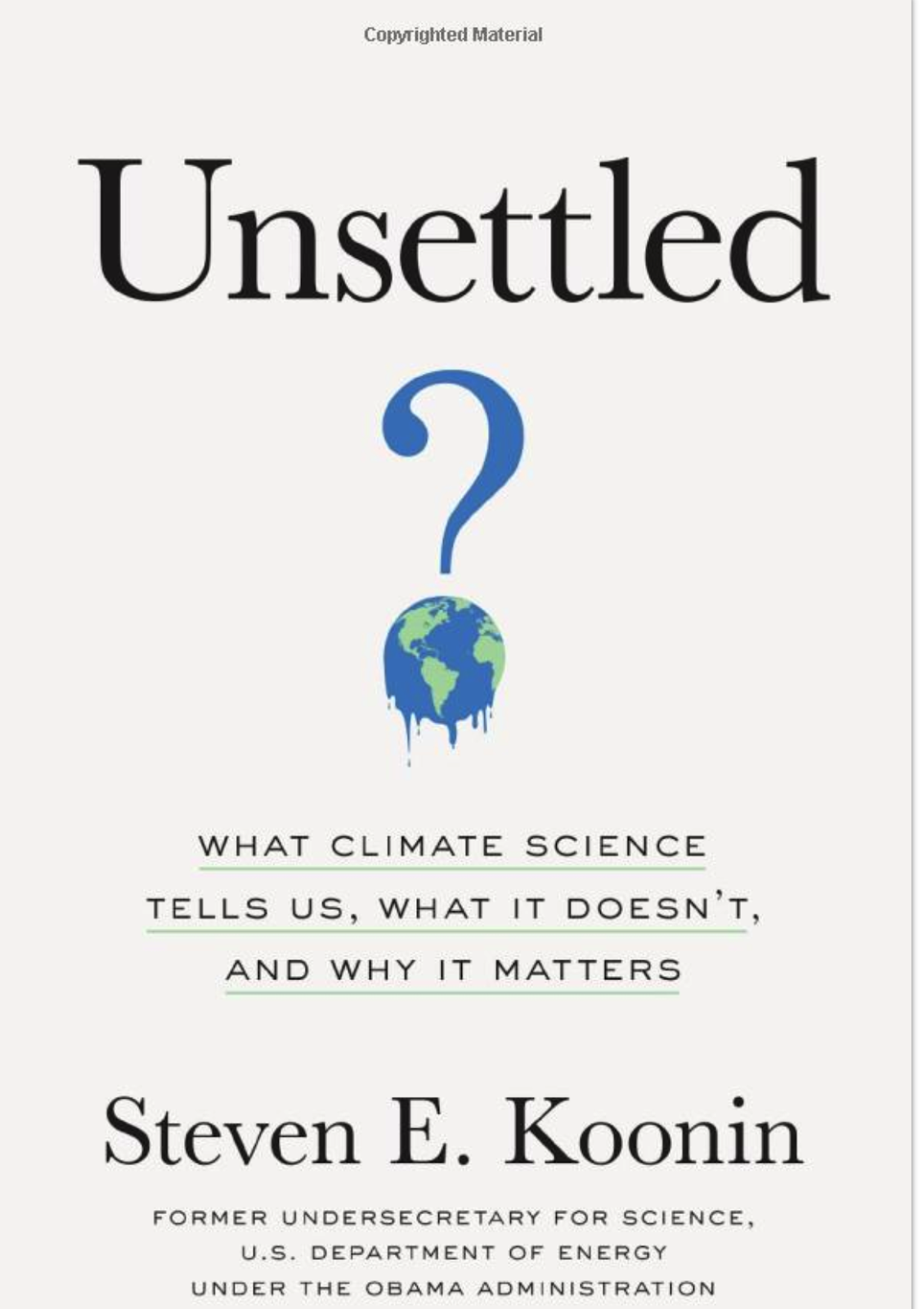
Unsettled
Inconvenient Truth
Inconvenient Facts
What We Know about Climate Change
The Physics of Climate Change
Delinquent Teenager
Taken By StormB
This Changes Everything
Climate Crisis and the Green New Deal 
The Great Climate Debate 
The False Promise of Green Energy
The Hockey Stick Illusion
Demystifying Climate Models
Is it Getting Hotter In Fresno or Not?
Hot Talk, Cold Science
How to Spend $75 Million To Make the World a Better Place
False Alarm
Numbers Don't Lie
Blowout


The Green New Deal Utopia

Any version of the widely discussed Green New Deal project must include these priorities: 1. Greenhouse gas emissions reductions will at least achieve the targets set in 2018 by the Intergovernmental Panel on Climate Change, namely a 45 percent reduction in global emissions by 2030 and the attainment of net zero emissions by 2050. 2. Investments to dramatically raise energy efficiency standards and equally dramatically expand the supply of solar, wind, and other clean, renewable energy sources will form the leading edge of the transition to a green economy in all regions of the world. 3. The green economy transition will not expose workers in the fossil fuel industry and other vulnerable groups to the plague of joblessness and the anxieties of economic insecurity. 4. Economic growth must proceed along a sustainable and egalitarian path, such that climate stabilization is unified with the equally important goals of expanding job opportunities and raising mass living standards for working people and the poor throughout the world.

Climate Crisis and the Global Green New Deal 

The Canadian version of the Green New Deal is the " LEAP Manifesto "  There is no way for me to capture the psychedelic nature of this manifesto here. Please read it for yourself. It's not long. Without actually reading this document, what I have to say about it will seem to be a rabid overreaction.

LEAP calls for an end to capitalism, the route of all evils, including climate change.  LEAP will end all forms of poverty and injustice, including the poverty and injustice created by LEAP itself. A careful reading reveals that LEAP is not just calling for an end to capitalism but an end to the economy. On the extreme far left, the "economy" is seen as an invention of capitalism. Once we dispel this illusion, anything is possible. The only historical precedent I can think of is Pol Pot's approach to getting things done without nasty things like incentives.  Pol Pot is sometimes thought of as a Marxist, but Marx was perhaps the world's first economist. Pol Pot was coming from quite a different place.

Climate "disaster" is presented in terms even more shrill than usual. Net zero by 2050 is assumed. The secret is switching to a command economy, tossing out the profit motive, and rationing fossil fuels to zero by 2050. A Universal Basic Income is included in the picture, making all citizens employees of the State, which makes sense since the fossil fuel industry will not only be nationalized but destroyed and "capitalist" incentives to work and create are rendered illegal.

The LEAP manifesto derives its urgency from the Climate Crisis--the "Deepest Crisis in Recent Memory." Without that, LEAP is simply a laundry list of the social justice agenda. It's worth asking if social justice would somehow be promoted by destroying the Canadian economy. LEAP deserves to be treated as "Far Left Activism." Unlike communists, they calling not for nationalization but outright destruction of major sectors of the economy. It's worth noting that Net Zero by 2050 includes major reductions, if not elimination, of cement and fertilizer, so it's not just the dirty business of fossil fuels to be destroyed. Construction and agriculture will take a hit. We would also face a problem importing most of the "Green" technology with almost nothing to trade for it. While Canada would look like Utopia to the Greens, to the rest of the world, it would be an economic basket case, cut off from the miracle of international trade simply because it has nothing to sell.

It's hard to imagine where the capital needed to re-tool the energy infrastructure for wind and solar will come from since the concept of private (capitalist) investment and profit is ruled out. In other words, any non-governmental agency would be expressly forbidden to make a return on investment. I have a hard time imagining how the current energy infrastructure and service level could be maintained. LEAP seems to be literally unable to keep the lights on. Ah, but I digress into economic considerations ...

Monday, 13 March 2023

What We Know About Climate Change (Kerry Emanuel)


(This is my Amazon Review)

The author is a genuine expert in his field. This is a quick read and worth your time. Considering the brevity, the reader will get an unusually clear explanation of factors like chaos and uncertainty. The author makes a good distinction between what is probably true and what is still uncertain. I appreciated his sketch of how computer models work.

Interestingly, he points out the shortcomings of the peer review process, which the IPCC tends to claim is a guarantee of accuracy. In fact, much of the research cited by the IPCC is not even peer-reviewed, which would have been worth mentioning.

Climate skeptics are presented as a politically motivated campaign to "discredit Climate Science." This is not helpful, especially when vast sums are being spent to hype alternative technologies ("Big Green").

There is an honest debate about the issues raised in this book.

---
PS: I appreciated his mention of next-generation nuclear as a factor in eventually reducing dependence on fossil fuels. This subject is often omitted in discussions of energy alternatives.

A Challenge to the "Settled Science" Meme

I've read at least a dozen books on the climate issue in the last month. This is the best. Koonin is not just another "skeptic." His approach to the matter rises above "controversy" and depends on evidence. Yet, he acknowledges where the panic is coming from.

A lecture by Koonin covers much of the key material and provides color versions of the slides, which are black and white in the book. Another interview, without the slides, is here.

In reading IPCC reports, it's evident that the "summaries" don't "summarize" the actual science. The ultimate summary, the speech by the head of the IPCC, bristles with inaccuracies and has no message beyond panic. As a senior climate scientist, Koonin provides some startling stories of the "blow-back" he gets by simply asking for an independent review of IPCC conclusions. In fact, there was a brief attempt to cripple such a review by denying federal funds to any study that challenged the consensus on the climate emergency. In fact, the first finding of such a challenge would be that there is no such consensus.

Proposed "solutions" to the "emergency" lack credibility. The media brings in climate alarms as part of their standard format, which assumes (without a shred of evidence) that every weather extreme is a sign of climate change and a sign things will be getting worse "unless we do something soon". Koonin points out that the biggest objection to emergency solutions is that climate problems (if they are real) are less important than global poverty - particularly energy poverty. He also provides a realistic "net zero" date as 2075. Even if that were achieved, C02 concentrations would continue to warm the planet for centuries.

He did tell me a few things I didn't know about C02. At a certain point, C02 will reach its maximum blocking effect. In other words, C02 "forcing" does not rise forever. The takeaway is that this maximum will be hit no matter what we do.

There is also a lesson on interpreting headlines that read "Hottest (coldest) day on record." Besides being simply part of the alarmist rhetoric, there are statistical errors behind the graphs that purport to show trends in temperature. If there is a trend, it is for temperatures to become "milder," with no real trend in the high but a trend in the low, meaning "less cold." "Less cold" doesn't get the headlines that "hotter" gets, nor do we see headlines that say "Today's Heatwave Not Unusual."

For those who really do want to get to the bottom of these issues, "Unsettled" is a long, cool drink of solid science. Koonin has 45 years of experience in the field at the most senior levels.  I was particularly impressed with his treatment of climate models, which added to my understanding, especially when it comes to trusting the models to provide information that would support the multi-trillion dollar investments proposed to overhaul society. 


Friday, 10 March 2023

Google Achieves Net Zero Results In Its Best Efforts Achieve Net-Zero

Notes on what happened with Google's efforts are here. "Utopians" tend to assume massive political change. Another popular thread is that the crazy pace of technological innovation will get us to Utopia. It's worth noting that the most famous technical company with infinitely deep pockets has written the effort off as a "learning exercise."

Here, the IPCC models and forecasts of catastrophe are more or less taken for granted. The entire piece relies on IPCC assumptions and models. The problem is, actually trying to reduce GHG turns out to be complicated (duh). In summary:

We’re glad that Google tried something ambitious with the RE<C initiative, and we’re proud to have been part of the project. But with 20/20 hindsight, we see that it didn’t go far enough, and that truly disruptive technologies are what our planet needs. To reverse climate change, our society requires something beyond today’s renewable energy technologies. Fortunately, new discoveries are changing the way we think about physics, nanotechnology, and biology all the time. While humanity is currently on a trajectory to severe climate change, this disaster can be averted if researchers aim for goals that seem nearly impossible.


We’re hopeful, because sometimes engineers and scientists do achieve the impossible. Consider the space program, which required outlandish inventions for the rockets that brought astronauts to the moon. MIT engineers constructed the lightweight and compact Apollo Guidance Computer, for example, using some of the first integrated circuits, and did this in the vacuum-tube era when computers filled rooms. Their achievements pushed computer science forward and helped create today’s wonderful wired world. Now, R&D dollars must go to inventors who are tackling the daunting energy challenge so they can boldly try out their crazy ideas. We can’t yet imagine which of these technologies will ultimately work and usher in a new era of prosperity—but the people of this prosperous future won’t be able to imagine how we lived without them.

Climate Crisis: A Reply to the Utopians


While I am sympathetic to many "Liberal" or "Socialist" ideas, I see that there are many still far to my "left." I refer to these as the "Utopian Far Left." Marx, Lenin, Mao, and Pol Pot would fall into this classification. The common thread is a promise of Utopia if only reason and individual rights are swept aside.

I take a close look at the inaugural address of the current head of the IPCC, Yensan-gun. My reasoning comes from many sources, but the reader who finds my thinking novel should refer to:

These are not isolated claims of the "climate denialists." It's just a matter of sticking to the facts, "running the numbers," and reading what the IPCC reports actually say at the "technical" level rather than the political "summary for decision makers." As information moves up the chain from actual research and data to the "summaries," uncertainty is removed, and the "party line" replaces expert opinion.


 Bold face and underline is my own of course. Comments in [].


From the inaugural address by the current IPCC chairman, Yensan-gun

9 June 2022

Bonn, Germany

Colleagues, Delegates,

I’m honoured to provide this keynote address at the opening ceremony of the first Technical Dialogue.

In the past 10 months, the Intergovernmental Panel on Climate Change has released a trilogy of reports providing policymakers with the most up-to-date science on climate change. These three reports are a dire warning about the consequences of inaction. Climate change is a grave and mounting threat to our well-being and a healthy planet.

[The need for urgent action is used to justify sweeping changes to the lifestyle of everyone on the planet. Historically, "urgent action" by Utopians has resulted in a catastrophe on an epic scale. This is a common political tactic. Among many objections, many point out that there are many problems that require urgent action. Action on one means inaction on the other. See Lomberg. It is also assumed that effective action is available - simply false (Gates). Historically, the grab for Utopia utterly fails (Morrison), but the costs have been real.] ...


The climate science is clear [very few issues are "clear" in the report. All have attached confidence levels]; our Physical Science Basis report concludes that: 
  • It is indisputable that human activities [vague] are causing climate change and 
  • Human influence is making extreme climate events, including [such as?] heat waves, heavy rainfall, and droughts, more frequent and severe [varying level of confidence but low in the categories listed. He is referring to model predictions that never have more than moderate confidence and disagree with each other]
  • Human activities have warmed the planet at a rate not seen in at least the past 2000 years, and  [Hockey stick in disguise]
  • we are on course to reach global warming of 1.5°C within the next two decades.

... a rapidly closing window [urgency again] to realize a sustainable, livable future for all [Utopia]. Climate impacts and risks are becoming increasingly complex and more difficult to manage [and imposible to model - in fact, always impossible to model]. Multiple climate hazards will occur simultaneously. Climate risks will interact with other threats to compound the overall risk. Risks will cascade across sectors and regions. [Always true of climate whether it changes or not]

Even temporarily exceeding 1.5°C warming will result in additional severe impacts, [how severe? Cost, feasibility of avoidance] some of which will be irreversible. [urgency again]  We are not on track to achieve a climate-resilient, sustainable world. Action on adaptation has increased, but progress is uneven, and we are not adapting fast enough [We are not on track to Utopia - true].

As the mitigation to climate change report concluded, we are not on track to limit warming to 1.5°C. Average annual GHG emissions during the last two decades were the highest in human history. Climate change is already affecting every region on Earth, in multiple ways. The changes we experience will increase with further warming. [Cause and effect is muddled here. Water vapor is the main GHG and a sign of life, not an "emission"]


Humanity is running out of time to limit global warming to 1.5° Cover pre-industrial levels. [Didn't he say we are not on track to 1.5?]

Yes, colleagues, we are at crossroads. Our actions today will shape how people adapt, and nature responds to increasing climate risks. [echos acceptance speaches of every politician ever. At last, I am in charge!]

The IPCC reports throughout this entire cycle focus on solutions. There are feasible and effective options [A bare-face lie] we can take to reduce the risks to people and nature, but their effectiveness decreases with increasing warming. [Any "effectiveness" at all remains to be demonstrated. Morris puts this kind of claim to the test, as it applies to "solutions" already tried]

Worldwide action to achieve climate resilience and sustainable development is more urgent than previously assessed. [GROWING urgency. The hockey stick.]

Climate action has been taken in many countries. There are policies, regulations, and market instruments that are proving effective. If these are scaled up along with climate finance and applied more widely and equitably, they can support deep emissions reductions and stimulate innovation. Moreover, our latest report shows that there are options available now in all sectors that can at least halve emissions by 2030. [total BS-Gates]
We have the tools and know-how required to limit warming. The decisions we make now can secure a liveable future. [Utopia]

....


June 10, 2022
NOTES:

The most compact and authoritative answer to Yensan-gun is "Unsettled," discussed in another post. The main point is that "Science" is far from settled and contradicts what was just said. The book provides an excellent description of how such nonsense floats to the top. The author is a respected client scientist whose credentials far outshine those of Yensan-gun.
----------
The consequences of a hotter planet include increasing incidences of heat extremes, heavy precipitation, droughts, sea level increases, biodiversity losses, and corresponding impacts on health, livelihoods, food security, water supply, and human security.
This mixes real problems (sea level rise) with hypothetical problems coming from the models and a broadly dark view of what humans will do to cope with change. The positive effects of change are completely ignored.

Chomsky, Noam; Pollin, Robert (2020-09-21T23:58:59.000). Climate Crisis and the Global Green New Deal. Verso Books. Kindle Edition. 


Thursday, 9 March 2023

Activist Capture of IPCC


I take this to be a perfect statement of the position of the Activist, Utopain "left". For the moment, I want this document to stand on its own. This is the language that has been percolating down throughout the IPCC "summaris for decision makers" since the beginning. I see little point in rebutting Mr. Yensan-gun one-by-one. His mind is plainlly made up.  Bold face and underline is my own of course.


From the inaugural address by the current IPCC chairman, Yensan-gun

9 June 2022

Bonn, Germany

Colleagues, Delegates,

I’m honoured to provide this keynote address at the opening ceremony of the first Technical Dialogue.

In the past 10 months, the Intergovernmental Panel on Climate Change has released a trilogy of reports providing policymakers with the most up-to-date science on climate change. These three reports are a dire warning about the consequences of inaction. Climate change is a grave and mounting threat to our well-being and a healthy planet.

...

The climate science is clear; our Physical Science Basis report concludes that: 
  • It is indisputable that human activities are causing climate change and 
  • Human influence is making extreme climate events, including heat waves, heavy rainfall, and droughts, more frequent and severe.
  • Human activities have warmed the planet at a rate not seen in at least the past 2000 years, and 
  • we are on course to reach global warming of 1.5°C within the next two decades.

... a rapidly closing window to realize a sustainable, livable future for all. Climate impacts and risks are becoming increasingly complex and more difficult to manage. Multiple climate hazards will occur simultaneously. Climate risks will interact with other threats to compound the overall risk. Risks will cascade across sectors and regions.

Even temporarily exceeding 1.5°C warming will result in additional severe impacts, some of which will be irreversible. We are not on track to achieve a climate-resilient, sustainable world. Action on adaptation has increased, but progress is uneven, and we are not adapting fast enough.

As the mitigation to climate change report concluded, we are not on track to limit warming to 1.5°C. Average annual GHG emissions during the last two decades were the highest in human history. Climate change is already affecting every region on Earth, in multiple ways. The changes we experience will increase with further warming.


Humanity is running out of time to limit global warming to 1.5° Cover pre-industrial levels.


Yes, colleagues, we are at crossroads. Our actions today will shape how people adapt, and nature responds to increasing climate risks.

The IPCC reports throughout this entire cycle focus on solutions. There are feasible and effective options we can take to reduce the risks to people and nature, but their effectiveness decreases with increasing warming.

Worldwide action to achieve climate resilience and sustainable development is more urgent than previously assessed.

Climate action has been taken in many countries. There are policies, regulations, and market instruments that are proving effective. If these are scaled up along with climate finance and applied more widely and equitably, they can support deep emissions reductions and stimulate innovation. Moreover, our latest report shows that there are options available now in all sectors that can at least halve emissions by 2030.
We have the tools and know-how required to limit warming. The decisions we make now can secure a liveable future.

....


June 10, 2022


]

Thursday, 2 March 2023

Inconvenient Truth / Inconvenient Facts

Many people, including my usually well-informed daughter, have not updated their picture of climate change from the apocalyptic tale told in "Truth." On the other hand, "Truth" has so much blatant bullshit that it is a low-hanging fruit for climate skeptics. Sadly, skeptics are more or less forced into refuting Gore's arguments which turn out to have almost nothing to do with the real question.

These two beautifully produced publications represent the poles of the polarized issue. Anyone who is interested in the topic has probably read at least one of them. For skeptics who have only laughed at isolated claims in "Truth," I recommend purchasing the book and holding it in your hands to absorb the whole impact and thrust of the presentation.

On the other hand, those who still regard the climate crisis as a real emergency should invest in a hard copy of "Facts." For better or worse, this book (specifically produced to defend the coal industry) has many skeptical issues that need to be considered. Is it right for the wrong reasons?

I leave out consideration of the IPCC, its methods, publications, and models. Closely related is what is now "settled policy" - that we can and should seek "net zero" by [fill in date]. All of that will be addressed in a different post.

Before getting down to the details, I'd like to mention some basic facts that both "sides" have come to agree on (more or less) since Inconvenient Facts was published.

  • Sea level has been rising since the end of the last Ice Age and is now rising at about 3 mm per year.  This is related to the fact that polar ice and glaciers have also been melting for thousands of years and still are. I deal with this issue in detail here.
  • Any prospect of humanity achieving "net neutral" carbon emissions is Science Fiction. The devil is in the details. Bill Gates (the ultimate detail guy) to me in "How to Avoid Climate Disaster" Ironically, at the time he wrote that, Bill seemed convinced there was a disaster around the corner. But by showing what it would take to avoid the disaster, Bill painted a Science Fiction world. There is a whole genre of books that say the same thing. Bill's is just the first one I read.
  • There is no sign that the world will develop and follow a plan to make a significant impact on climate changewhether or not such a thing is possible. There is no plan. There is no plan to make a plan. It is worth noting that, even if the IPCC's models were believed and urgent recommendations were followed, "Net Zero" would still be centuries away. As long as the current laws of physics remain what they are, there is no possibility that any future technology will replace fossil fuels and/or nuclear energy. Sorry, the math doesn't work out for the wind farms and solar panels.
  • Mining is at the heart of technology. Ugly though it is, we will need to mine the materials we need to use for any future energy source. That includes lithium for batteries.
  • "Nature" is in a constant state of flux. All statements in the physics of climate are dynamic in the sense that they describe change - the way any given state of nature leads to another. Chaos, not "balance," is the way to think of nature.
So, what are the "takeaway" messages from our two books? Let Mr. Gore go first.

The subtitle on the cover reads "the crisis of global warming." Now we call it "climate change" since it turns out the actual climate is not warming in a sufficiently scary manner. But we have a "crisis" right off the bat.

What is the crisis? You would think this would be easy to find out by reading the book, but the book is a laundry list of horrors along with compelling graphics to illustrate each one:
  • Mining.
  • Population growth
  • Something about polar bears
  • Something about penguins
  • Something about "disrupting the balance of nature as we know it."
  • Pollution
  • (over) population
  • Ocean currents ...
and so on. But where is the crisis? Floods, hurricanes, and tornadoes are depicted - supposedly all part of the "big picture" of the crisis.

When you get right down to it, the book assumes without a shred of proof that C02 emissions are an emergency. The rise in C02 concentration gets a two-page spread. The greenhouse effect is presented in a manner suitable for little children (and still is presented for children). The fact that C02 is a minor greenhouse gas (the major one is water) is not mentioned, nor is the fact that greenhouse "forcing" is one of the thousands of barely-understood influences on climate. But C02 has one big advantage. It's our fault. 

Between the lines is a claim that the climate is well enough understood that we know there is an emergency and must act now. Gore is optimistic that we can turn things around. Windmills. Solar Cells. Nuclear only appears in the form of bombs. The book is for dummies, so we don't get into the math of just how this will work.

We are stuck with getting 80% of our energy from fossil fuels for the foreseeable future. The only question is, will this destroy the planet? This is the theme of the book. But there is nothing worth the name of evidence offered.

Gore attempts (quite successfully) to create panic over a wildly exaggerated issue. We still have the panic. But he has a way of fixing things. Where have we heard that from a politician before?

Let's hear from the other side:


Gregory Wrightstone is the executive director of the C02 Coalition, whose goal is stated on their web page:

The CO2 Coalition was established in 2015 as a non-partisan educational foundation ... for the purpose of educating thought leaders, policymakers, and the public about the important contribution made by carbon dioxide to our lives and the economy. The Coalition seeks to engage in an informed and dispassionate discussion of climate change, humans’ role in the climate system, the limitations of climate models, and the consequences of mandated reductions in CO2 emissions.

Major donors to this "coalition" include the "usual suspects," such as the Koch Brothers and the Mercers, who have funded such "non-partisan" projects as Fox News.  It is no coincidence that Wrightstone is a frequent "talking head" on Fox. The common thread of these projects is to present "alternative facts" in a format that superficially resembles the way that actual facts are presented.

The "inconvenient fact" about who pays Wrightsone's rent is omitted from the book. I have never seen it mentioned in Wrightstone's "qualifications" when he appears online. This book is part of the "educational" goal of the C02 Coalition. To claim it is "non-partisan" and "dispassionate" is simply laughable.

The book is wonderfully produced, full of nice color graphs and Wrightsone's well-honed rhetoric, which you can sample in numerous videos (mostly on Fox News) without buying the book. He weaves fascinating information about the Earth's past (what is true ain't new) along with "facts" coming only from hard-core Climate Skeptics such as Craig Idso, who served as Peabody's climate denier in chief (Peabody is "big coal").  "What is new ain't true."

This book collects all the "talking points" of climate skeptics between two covers. For those who are routinely confronted by climate skeptics, it's useful to know their playbook. The key well-known "fact" it presents is that climate has been changing for the whole history of the. Earth, and THEREFORE, we are OK. Nothing to see here. It's like saying volcanos have always been happening, so don't worry about living on a volcano.

But those who think we have a climate emergency are concerned about a particularly fast, nasty, and totally unprecedented change in climate, entirely created by Wrightestones's financial supporters.  Wrightstone never directly addresses this issue. The reader is left to come to his own conclusions, which assumes that the typical reader actually knows the claims of Al Gore and company in detail.

Another assumption that both "sides" make is that the average reader understands graphs. As a former math teacher, I assure you that such skills are rare in the general population, and it's easy to fool those who do. Even me.

So the average reader may wade through all the pretty graphs and miss the treatment of ocean levels rising (Page 114 and following). This destroys the #1 image people have of global warming: cities swallowed by the ocean. This is fatal to Al Gore's picture of catastrophe. The actual amount of sea level rise will be dwarfed by the rise in "normal" hurricanes for thousands of years.

It's a classic case of "too much information." Similar arguments about temperature changes happening over centuries are buried in accounts that reveal the author's wide knowledge of history. But, again, we are talking about .5 degrees C, a difference few of us would notice. Again, such differences are buried in the extremes of heat and cold. 

Gore's followers, faced with a paucity of evidence for increased hurricane activity, alarmists have claimed that climate change is producing more extremes. Here again, the Wrightstone drowns the baby in the bathwater. We are not seeing trends in the frequency or seriousness of hurricanes, for example. It's not easy to dig out that fact in this book, and the author actually claims hurricanes are decreasing. What he needs to calm the panic is just that the increase is unproven. It's not in the data. His hand-drawn "trend lines" on pages 96-97 do nothing but raise suspicions of cherry-picking. Those of us who love graphs hate hand-drawn trend lines.

Wrightsone seems to be unaware of how central climate emergencies are in the "Inconvenient Facts" mindset. True believers walk away thinking that this and virtually all bad weather is the result of climate change. This idea is constantly in the headlines. It needs to be addressed head-on, but the author buries it in graphs of crop yields.

Wrightstone has earned his keep by digging deep to find everything he knows to prove that coal is good for you. In his enthusiasm, he misses the point. Are we faced with a climate emergency or not? If so, is an excess of C02 responsible?

To be honest, the only way I found answers to these questions in Wrightstone's book was to know them in advance. The answer is "no" and "probably not." Wrightsone is right for all the wrong reasons.


Models - Climate and Other

Here is where I started on my self-directed course in "Climate Models 101". This is highly recommended. Here's a sample:


My M. Sc. in math allows me to at least read these equations, if not understand them. I note the caveat at the bottom, which admits right off the top that these equations assume a world that is not quite ours. This theme is repeated over and over in the IPCC reports but pushed aside in the "executive summaries." I do happen to know that these equations describe a chaotic physical situation, even in the ideal case, which means they cannot be used to predict anything with confidence. In fact, this discovery was what launched the whole field of Chaos Theory. The clue is that some entities appear on both sides of the equations above, a sign that the system has feedback. Feedback is the fingerprint of chaos. We also see the IPCC models struggling with feedback.

With this background, I move on to the "meat and potatoes" of Climate Science:


"Demystifying Climate Models" is thorough, readable, and completely free from Amazon (and perhaps other sources). It's essential reading for anyone trying to decipher IPCC reports. The book gets down and dirty in the details. There is no math in the book, but those who understand the math (such as from "Physics of Climate Change" will get a fairly good idea of how that math figures into climate modeling. 

One subtle point we should notice. All diagrams are mini-models, whether they are "marching bars" or the more sophisticated conceptual model below. Virtually all of the economics you learn in the "101" course is in terms of conceptual models with graphical expression. They do not reflect the real world. That is an entirely different matter.

A key takeaway from the "Demystifying" book is illustrated by the graph below:


Total Uncertainty

Several factors affect how much we can trust a model:
  • Initial condition uncertainty (green) reflects uncertainty in our knowledge of the present situation or (if the model is run on the past, say 1000 years ago) how uncertain we are about the conditions then. For me, the key here is that the models are not great at "predicting the past" since our detailed knowledge of the past is sketchy.
  • Scenario uncertainty reflects our uncertainty about some future scenarios. What kind of a word will we be talking about? In the IPCC, there are standardized scenarios that reflect C02 emissions according to human decision-making. This goes a long way to nailing down exactly the world we are talking about, but the scenarios may not describe that future world well.
  • Model uncertainty comes from all kinds of potential errors in the models, which are discussed in detail in the book. The most interesting one relates to the difficulty models have in representing small-scale events such as hurricanes. In general, handling water is tricky, and water is by far the most important greenhouse gas.
I was surprised to find that there are models for specific systems, such as the ocean, land, atmosphere, and ice. Each model type is developed separately according to the most relevant science. These are then "bolted together" by a process called "coupling," which attempts to make things consistent where the different systems overlap or come in contact - where the atmosphere touches the Earth, for example.


Obviously, coupling is a major source of "model uncertainty."
 
IPCC Model Interaction

The book gets into how each model divides the earth into grids or chunks. The chunks need not be all the same size. Some attempt is made to make the grid finer where expected effects will vary at a small scale, such as over cities or cropland. Different models (say ocean and atmosphere) need not use the same grid, nor will different versions of the same model type use the same grid, since you can "plug in" different models, say, for atmospheric aerosols. That depends on what you want to get out of the model, which is perhaps the most important point in the entire book. You configure your model for a specific purpose - to support some decision process or answer some specific question.

It is left to the reader to decide if the crazy zoo of models produces information to support decision-makers, as the IPCC desires. While they don't quite come out and say so, very few people have the background to understand what the models are doing, to explain the results, or to develop policies in response. In other words, the usefulness of climate science is in the eye of the beholder.

I was impressed by one remark: that uncertainty should not be used as a reason for a policy decision, such as inaction. In such a situation, more certainty is unlikely to change the decision. That's something to wrap your head around. Call it the "uncertainty fallacy."

A minor surprise was how the model can be pretty good for one measure, say surface temperature, but no help for another, say ocean level rise. It turns out that the more we know about the ocean's surface level, the crazier it gets. For example, if you go from the East Coast of the US toward Africa, you are going uphill! The ocean is actually a bit tilted. Also, the land is sinking in some places (Virginia coast) and rising in others (Greenland).  Flooding is a major source of climate panic (including in "Physics of Climate Change") but climate models don't do a good job of dealing with such small variations and uncertain data. Another is with hurricanes, which are "small" by model grid standards. Models do a bad job of simulating hurricanes, yet the panic doctrine always claims frequency and severity of hurricanes is getting worse and worse.

I get the impression that the model's general prediction of temperature changes is pretty trustworthy, for example, in the Arctic. On the other hand, all the other disastrous implications are less certain or not in the models at all. For example, we can be pretty sure the Arctic will get warm but far less certain if or when the ice cap will melt. That's because "ice" is a separate block in the model and subject to the poorly understood nature of water vapor, which, I remind you, is the main greenhouse gas.

I hope I have encouraged the reader to pick up this book. After all, I am giving a summary of a summary here. It's particularly valuable if you intend to go ahead and actually read the IPCC report instead of assuming what's in it or assuming it's bunk.

===========
P.S. It has occurred to me that the shotgun marriage (coupling) between independent models in the climate field is rarely attempted between models in other fields, which, in theory, should describe the same world:

  • Ecology - specific effects on living systems;
  • Materials requirements, such as supply and demand for lithium, copper, etc.;
  • Demographic models - changing effects of an aging population;
  • Projections of global wealth;
  • Remediation programs associated with IPCC Climate Models;
  • Geopolitical models that consider the impact of new alignments and trade blocks;
  • Fine-tuned consideration of the actual standard of living improvements in the developing world;
  • Impact of AI and robotics (another apocalyptic scenario).
  • Insect Apocalypse;
  • Fresh Water use/shortage - the "Global Hydrological System";
  • The general collapse of the ecosystem;
For example, in the box marked "Humans" above, all human factors are collapsed into a handful of scenarios. In the worst case (business as usual), the world population is assumed to hit 14 billion by the end of the century. This is not what population models predict (9 billion peak seems to be the consensus number). The same models assume growing GDP and associated consumption, ignoring the effect and spiraling prices for materials such as copper.  Proposed "Net-Zero" utopias ignore the need for copper in all forms of generators, including wind and solar. Fifth-generation nuclear gets rosy treatment, ignoring the geopolitical problems in acquiring and sharing technology. Huge costs associated with rebuilding our supply chains in response to geopolitical changes (such as China vs. the US) are seldom considered. Our current energy-intensive global supply chains (and global peace) are assumed to be available to make everything from nuclear reactors to windmills.