Showing posts with label surfaces and essences. Show all posts

Sunday, 28 January 2024

A Chat with AI about "Surfaces and Essences" and "Feeling and Knowing"

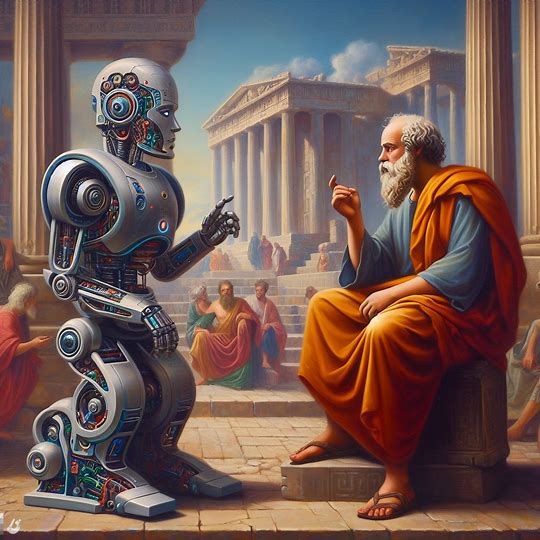
Image courtesy of BING AI

AI Provides a helpful summary of its own summaries:

The book "Surface and Essences" by Douglas Hofstadter and Emmanuel Sander explores key concepts related to human thought and language. It emphasizes the importance of analogy, category, essence, metaphor, blending, pattern recognition, and recursive thinking in shaping our understanding and creative thinking. The book challenges conventional wisdom and offers insights into perceiving, understanding, and creating meaning. (I) value the book for its insights into systematic thought and the limitations of language.

 (I) also mention Antonio Damasio's book "Feeling and Knowing: Making Minds," which explores the relationship between emotions and cognition. Damasio argues that emotions play a crucial role in guiding our thoughts and actions and that our sense of self is shaped by emotional experiences. Overall, both books offer comprehensive perspectives on human cognition and consciousness. 

------------------------ 

AI: "Surface and Essences" is a book written by Douglas Hofstadter and Emmanuel Sander. It explores the nature of human thought and language, focusing on various key concepts. Here are some of the main concepts discussed in the book:

1. Analogy: The authors argue that analogy is the foundation of human thought. They believe that our mind constantly seeks similarities and patterns to make sense of the world, and that analogical thinking is an essential aspect of creativity and learning.

2. Category: The book explores the nature of categorization and how it shapes our understanding of the world. It suggests that categories are not fixed or rigid, but rather dynamic and evolving, influenced by context, culture, and individual experiences.

3. Essence: The authors challenge the idea of essentialism, which posits that objects or concepts have inherent properties that define their true nature. Instead, they propose that essentialism is a mental shortcut that neglects the complexity and fluidity of how we perceive and understand things.

4. Metaphor: Hofstadter and Sander argue that metaphor is not just a linguistic device but a fundamental mechanism of cognition. They explore how metaphors shape our thinking, influence our understanding, and bridge the gap between diverse domains.

5. Blending: The concept of blending refers to the creative synthesis of ideas or mental spaces, combining elements from different domains to produce novel and imaginative thoughts. The authors delve into the role of blending in humor, problem-solving, and creativity.

6. Pattern recognition: The book emphasizes the importance of pattern recognition in human cognition. It suggests that humans are naturally inclined to detect and create patterns, which helps us make sense of the world and generate new insights.

7. Recursive thinking: The authors discuss the concept of recursion, which refers to the iterative and self-referential nature of human thought. They argue that recursion allows us to think about thinking itself and is crucial for understanding language, consciousness, and creativity.

Overall, "Surface and Essences" focuses on the interplay between similarity and difference, patterns and exceptions, and surface appearances and underlying essences in human cognition and language. The book seeks to challenge conventional wisdom and offer novel insights into how we perceive, understand, and create meaning.

I have valued this book for decades. It provides insight into how the mind works, especially regarding "systematic thought," which includes language. In a way, we are trapped in a "large language model" where the meaning of anything can only be "explained" in terms of analogy with something else. The only way out of the labyrinth is to find little exit holes - exits to the light, where ideas that are not "like" anything else. Quantum mechanics is my favourite example.

My experience is that people have a problem understanding this trap. What we really "know" is based on experience, but almost all we "know" is a thicket of "explanations" a circular definitions, examples, analogies and metaphors. A counter-example is pain, which we "know" without explanation. Not coincidentally experience of pain doesn't require a mind that uses language. Animals feel pain.

According to Antonio Damasio, feeling and knowing mean something separate from language. Animals can "know" things, but their minds are still information systems. Just not "large language models".

"Feeling and Knowing: Making Minds" by Antonio Damasio explores the relationship between emotions and cognition, shedding light on how they together shape our conscious experiences and decision-making processes. (Damasio's "mind" is not a product of language):

Damasio argues that emotions play a crucial role in guiding our thoughts and actions, asserting that they are not separate from reason but rather integral to it. He suggests that emotions are the key drivers behind our attention and memory processes, influencing the way we perceive and interpret the world around us.

Furthermore, Damasio explores the concept of consciousness and self-awareness, proposing that they emerge from the integration of various mental processes, including emotions. He suggests that our sense of self is not just a result of rational thought or intellectual abilities, but rather a product of emotional experiences that create a narrative about ourselves.

In the book, Damasio also delves into the concept of feelings and their relationship with the body. He argues that our bodily feelings, such as pain or pleasure, are not separate from our mental processes but rather intimately connected to them. These bodily feelings are seen as the foundation upon which our emotions and subjective experiences are built.

Overall, Damasio's "Feeling and Knowing: Making Minds" explores the intricate interplay between emotions, cognition, consciousness, and the body, providing a comprehensive understanding of how these factors shape the human mind.

This sharpens our idea of the "information system" in our skulls. Emotions and feelings can be thought of as "states of mind," but we get away from the idea that "information systems" need to be digital or language-based. Panic and pain are "ideas" about the world. These emotional responses are partly generated from memories of past experiences - close to what humans call "self-awareness", the kernel of "consciousness".


Sunday, 12 June 2022

Belyea Rd - Isomorphisms, Virtual Reality, Augmented Reality

Thinking about how our "normal" experience is deeply analogous (isomorphic) with virtual reality.

We all have a different idea of what is going on "beneath the surface" but much of this depends on language.

The "Matrix" idea is not as interesting as people think. In that fantasy people still have a real brain. Whether or not we actually do have a real brain or just an illusion of one seems to be hardly worth discussing. What is worth discussing is how interaction with the real world (or something!!) turns into the rich "gold standard" VR of everyday life.

Friday, 27 May 2022

A Random Talk

This is an experimental blog post. The idea was to simply talk about a range of issues with the aim of creating a "mind map", then using the map to create traditional posts that are more structured and focused. But along the way, I wondered if I could post the original voice note

So, to test this, click on the link below, which will show you a LINK to the audio Store that and play it. Your machine will probably have an app that plays audio. In my case, it's iTunes.

This talk can be indexed just like a text essay.

In the long run, the plan is to take notes on my own "rant" in mind map form (which can also be shown in the blog).


A Random Talk

Sunday, 27 February 2022

Frames, Surfaces, Reading


Proust and the Squid is a classic analysis of reading. Reading is a learned activity that involves nested multi-tasking between 

  • Character recognition
  • Word recognition
  • Sentence parsing 
  • Context detection
  • Imagination - the oldest form of Virtual Reality
  • Criticism 
Both Hawkins' Frame theory and Surfaces and Essences analogy-based theory is relevant. I lost the actual hard copy but finally remembered the title and bought the book for Kindle.

Thursday, 4 April 2019

Summary April 4, 2019

BOXES

One fanciful vision of the (flat) Earth was that it was supported on the back of a turtle, which was, in turn, standing on another turtle and so on: Turtles all the way down.

Similarly, I find it useful to think of "boxes within boxes all the way down." Box 1 is the world we experience "in our head," which includes all experience and everything we know. In particular, it includes what we have been taught and what we have been taught to assume, which is, to a certain extent, "programmed". Box 1 is the "matrix" of individually shared reality. But, unlike the Matrix of Science Fiction fame, our matrix depends deeply on the "real world" outside and our senses within, as eloquently explained by Antonio Damasio.

Our evolutionary survival strategy involves survival as a member of a group, or "super person". Not only do we not "think for ourselves," we can't.

We experience ourselves as objects in the world (that's me) and assume that the world exists without us. It has been here long before we were born, will still be here long after and exposes only a tiny amount of itself to our investigation. This is "Box 2". Box 2 is contained in Box 1. Thinking in "box 2" terms, we recognize that other people exist and that they have an internal world - their "Box 1" which is, to us, Box 3. Of course, there are billions of Box 3's, including Box 3's that belonged to people long dead. We are in "Box 3" when we say things like "I know what he's thinking". Language uniquely provides access to Box 3, when we ask things like "What do you see" and expect an answer that makes sense. It can get pretty crazy. It makes sense to ask if Galileo correctly understood the discoveries and system of Kepler (he didn't). In a similar vein, we can ask of the Church threatened Galileo because of his beliefs or because he was, according to what was known at the time, wrong. All this depends on an acceptance of the fact that each of us lives in our personal "Box 1". This is an unavoidable consequence of our nature. It follows that persecuting an individual for his beliefs is misguided since nobody really "thinks for themselves."

When we are speaking of experience or "external reality," we need to be aware of which "box" we are speaking from. For example, statements about objective reality belong in Box 2 and should not contain "mind-like" concepts like the "laws" of physics. Laws of physics belong in Box 1. They are statements about our experience of the world.

I allow for "Box 0", which is the hypothetical and unobservable world - beyond the reach of our cleverest instruments, observation or reasoning. Like Box 1, Box 0 is relative. We are always biting chunks off Box 0, but we must admit that there are things we will never know about the Universe. At the very least, we must, as individuals, recognize that almost all of Box 0 is beyond what we will ever understand. I assume that "Box 0" exists even if there are no observers anywhere - the situation we assume at the time of the Big Bang and millions of years after that.

I regard all of mathematics as being in "Box 1" as something "mind like." This stands against the common intuition of physicists that the Universe is somehow fundamentally "mathematical" and that we are "discovering" mathematical laws that exist apart from our minds. This assumption is certainly worth challenging, but it's good to make it explicit. Similarly, any statement that includes an "observer" or an "apparatus" is a statement in Box 1, not Box 0.  As far as I know, such "mind like" concepts can be removed from relativity and quantum mechanics without losing anything but hooks for idle philosophers to make their speculations sound "scientific."

"Theory of Boxes" takes a dim view of theories that attempt to explain either of these questions:
I am greatly aided in this skepticism by knowing that not all perfectly sensible questions have answers.  While it has not been proven that either of the above questions is formally undecidable, I think it's reasonable to think of them in this way until some future genius settles the matter. For now, at least, I proceed on the assumption that we have something called "experience" and that it is an experience of something other than ourselves. Not much of a stretch I think.

THE INTERFACE

In effect, what we call "mind" is an interface between the "real world" and "Box 1". You could say it's responsible for creating the whole stack of boxes. It is worth asking how it does this, which boils down to curiosity about neuroscience - the brain. More subtly, it involves asking about the nature of the universe we inhabit and what it takes to survive in it.

In this area of concern, we also consider how the interface is "programmed" by language and other cultural factors. Analogy plays a key role here, as outlined in "Surfaces and Essences". A key concept in that books is "isomorphism" - the idea that some analogies are better than others. In fact, the best ones allow us to learn about one system from the properties of another. For example, we assume that objects in the universe behave as if they "obey" laws of gravity (mind-like ideas). Thus, we can predict how objects will behave (say the date of an eclipse) by working out the math in the model. On a broader scale, we can ask which of our ideas genuinely underpin reality itself, the subject of "A Beautiful Question".

Evolution has gifted humans with an obsession with "figuring out what's really going on". Many of our guesses are wide of the mark and wind up as "mythology". Some are impressively robust and useful - they are called "Science". So far, we can't be sure how closely our ideas mirror the "real world", but we can help ourselves by keeping in mind the difference between our ideas (mind-like) and the actual reality we attempt to approach.


Wednesday, 6 March 2019

If The Only Tool You Have ...

"If the only tool you have is a hammer, everything looks like a nail".

Most people shy away from simple math. In fact, publishers demand that no equations, however simply don't appear in popular books.

From this perspective, the simple graphs and equations that appear in introductory textbooks appear sophisticated. In particular, these tools have a hard time presenting anything but a super simple, static picture of the world.

If you approach the same situation with different tools, a very different picture emerges. Even simple computer simulations can show complex behavior that can't be reduced to equations of any sort.

I played around with this idea a bit but abandoned it because it would have involved an unrealistic effort to implement it. However, even while simply drawing up a specification, you can see the kind of things a model could address. Most important is the question of stability or even a stable pattern of oscillation. Model specifications seem to raise the possibility of chaos or ultimate collapse.

This is interesting because:
  • The myth of the invisible hand is a static view. Any change will ultimately involve the system settling down to a new, stable state. An "optimum" state.  In a computer model, this is not assumed. You need to run the model. But the model specifications show a system that is likely to show chaotic (unpredictable) behavior.
  • Any realistic model includes "environmental services", which are routinely left out of the conventional analysis. Even in a simple model, the inclusion of the environment raises the question of collapse either by exhaustion of finite resources or by exploitation of resources faster than they can be replaced. Any model that includes human population will assume that human population until limits of "environmental services" collapse.
If you are a thinker, eventually you need to come up with some idea of thinking itself. For me, "Surfaces and Essences" provides a "Royal Road" to the way our minds work. While the book has a focus on analogies in language, the final chapters shift to visual analogies and the role analogies play in scientific theory. What is the world "really like". The idea of "essences" in the title is that some analogies are better than others. The best ones provide a two-way isomorphism, where properties in one system can be deduced from (mapped on to) properties in another. Analogies are rarely this good.

A persistent problem with public discussion is that naive analogy underly the way we use language to describe an issue. Here is an explicit visualization that supposedly "explains" the business "cycle":


If you look up "business cycle", it is remarkable how smooth and neat the "waves" are. The same mental image seems to be in the mind of "climate change deniers". The assumption is "what goes up will come down".

The problem with this analogy is that it is far from "essential". It doesn't really tell us anything about the phenomenon of interest.

Real economic data looks much "rougher". It was Mandelbrot who discovered the real "shape" of curves like this - fractal.

Real Economy - The Stock Market


Fractals turn up frequently in nature. They exhibit a special kind of "randomness" that looks the same at every scale. In practice, even serious investors in the stock market are unfamiliar with this fact. In effect, the "wave" idea and the "trend" concept are forced into the data (usually in retrospect). These methods are famously unable to predict large changes, such as the 2008 crash. The easiest way to see this is that the wavey graphs are not an "essential" analog to the real economy. Climate change deniers are not familiar with any other way to see this kind of thing, yet the IPCC reports are full of graphs like this. In fact, under the surface, the IPCC models are massively complex. They don't depend on "wave" models, but on the way physical factors are known to interact. Weather is one of the first systems discovered to be ruled by chaos. We can expect nothing different from weather over the long term - climate.

The most trivial kind of graph is "marching bars", showing some quantity in a series of bars over time. Using a line instead of bars is a simple improvement, but still relies on the assumption that graphing X over time reveals the "essence" of the system under consideration. Those who have seen nothing else, and were perhaps confused by the examples they did see have a hard time visualizing an alternative. See if this graph makes sense to you:

How the quantity of sorghum produced depends on the Price
"Time" doesn't appear in this graph. In fact, the graph is a visualization of a few simple equations that supposedly illustrate certain "price points" and how they relate independent of time. This is an improvement over "marching bars", but the underlying "math" is trivial. Like all graphical methods, all data and factors that may be of interest are necessarily ignored for the sake of simplicity. Economics textbooks are full of this kind of graph, giving them an undeserved impression of sophistication.

A computer simulation is not limited to a few simplistic assumptions. Predictably, the outcome, depicted graphically, is not as neat as marching bars or waves.
An Output from "Symphony" Simulator
Compared to practical simulations such as those used to simulate climate, Symphony is a toy that makes little effort to map its model into real, objective facts or the relationships between them. What many would see in the above graph as "waves" I see as instability. Think of it this way, if your car wobbles from left to right on the highway, you will assume that there is something seriously wrong - not that it's designed to do that. You will suspect that quite soon, your car will wobble into the ditch. Historically, this is what modern economies actually do: they "wave around" for a cycle or two, then unexpectedly boom or crash.

We can be quite sure that there is not even a toy simulation behind most of the economic "stimulus" packages flogged to the voters. Especially when coming from the conservative politician, such policy seems to be based on (a) the invisible hand and (b) the idea that the economy is inherently stable and (c) at any given time, we are someplace on the "business cycle". One may assume that, behind the scenes, there are thousands of nerds playing with economic simulations. Unlike the IPCC, they don't release their methods, data or assumptions for public debate.

By the way, the IOUTopia model would have been at least as complex as "Symphony" with the additional complexity of finding a way to simulate the goals of thousands of individuals over generations. A glance behind the scenes at what the programmer sees when creating a Symphony model should give a hint at why I abandoned the IOUTopia model. I still hope somebody else does it.

The Symphony "sausage factory"

Rolesia is another economic simulator apparently similar in power, scope, and applicability to Symphony. They resemble IOUTopia only in showing the amount of effort that would go into making something like this. As far as I know, there is nothing out there that has the granularity envisioned in IOUTopia. These simulators appear to be tools for professionals who want to put a modicum of objectivity into their economic forecasts, using assumptions that are applicable to today's economy. IOUTopia was a tool to investigate the basics of what an economy is.

Sunday, 4 June 2017

Whatever Happened to the Meme?

The idea of the meme was invented by Richard Dawkins and hammered into its most robust form by Daniel Dennett. It is an extended analogy that claims that human ideas are somehow like genes and have their own process of evolution independent of the evolution going on in their "hosts", the human race.

It's an attractive idea and it works well as a rhetorical device, especially the way that Dawkins and Dennett use it to attack religion as an infection of the brain. True believers in "memetics" claim that all of human thought is "infection" by memes - a strong claim that memetics is a fundamental explanation of mind. Memeticists claim that the brain is a "meme machine".

The problem comes when you try to apply memes outside of the examples trotted out by the "founders". Personally, I can't figure out what a "meme" is. The old words of ideas, doctrines, theories and especially paradigm seem perfectly serviceable and don't easily translate themselves into "meme talk".

It is worth noting that respected investigators of "mind", such as Hofstadter, bypass the idea of "meme" entirely in spite of being on cordial terms with the founders of the idea. For them, it's not just a wrong idea but one not worth mentioning. "It's not even wrong".

It looks like the basic "atom" of thought, especially linguistic thought (the inner voice), is the analogy, as worked out in "Surfaces and Essences". If we start with this idea, memes must be some kind of "extended analogy" or complex of analogies. However, our mental "analogy computers" process the tangle of analogies in language at lightening speed and mostly below our level of awareness. This doesn't line up well with the "meme" idea, where it seems to be assumed that people can be "talked out" of memes (disinfected) by conscious, logical argument.

In fact, analogy processing is buried in language itself and not the "memes" that have somehow "infected" our minds. If the infection is to be found at all, it is to be found in the language, not the brain. But the analogy of infection breaks down when we study language in general, not the cherry-picked poster children of memetics. For the most part, the analogies that underlie language are benign and somewhat inevitable, given the need to "boot strap" our language from almost zero. The example of "under-stand" comes to mind. How is standing under related to "understand". If you think about it, it makes a lot of sense. Maybe it's a "meme" but do we need the "meme" idea to make sense of it? Does it make sense to think of this analogy as "surviving" on its own according to some pseudo-Darwinian principles, rather than its roots in human experience? What does "memetics" add to our understanding?

Hofstadter's concept is that some analogies are better than others. They are the "essential" analogies, the ones that come closest to isomorphic mappings between one situation and another. This would seem to claim that is the truth or at least "usefulness", not "survival of the fittest" that makes some ideas prevail over others in the long term. I'd go further and claim that it is our hard-wired preference for symmetry that makes one idea seem better than another. This comes pretty close to common sense about the matter. Is memetics providing a meaningful challenge to common sense?

There is a human tendency to regard people who disagree with us as being "infected", insane and impervious to logic. We are the logical ones. They are ignoring the evidence. Especially when seen in its early forms (attack against religious thinking), memetics is simply a put-down of of stupid people who fail to appreciate the majestic logic and superior mind of Richard Dawkins. Dennett smoothed over the rough edges and gave us some real insight about where "memes" come from, such as the idea that no person needs to "have" an idea, such as the great idea of evolution. But in defending the meme, Dennett has basically moved beyond it. Dennett's memetics doesn't need memetics.

Is there anything we can understand using memetics that can't be understood without it? As it has been said of Freud: "What  is true isn't new and what is new isn't true".

Wrong theories provide special insight by providing us with a new perspective on the problem, like footholds as we climb the mountain, to be used for a moment then discarded.

Sunday, 23 April 2017

The Brain As an Amazing Symmetry Computer

I have a coffee cup in front of me (I usually do). If I rotate it or move or see it in different light it my brain automatically makes me experience it as the same cup. If you have ever tried to make a computer figure this out, you will see how astonishing this is. What's more, the cup will be seen as the same cup tomorrow and the same as the cup that I washed a week ago (or is it two weeks? The point is, that doesn't matter). This is symmetry under a transformation in time and space. It takes place so automatically that most of us will go through our entire lives without thinking of it at all.

There is another, related, trick that the brain does. It makes me "see" the cup as a form. A form is a bunch of "stuff" that is more or less arbitrarily treated as the "same thing". My dog is quite capable of seeing a flying tennis ball as a "thing" that can be snatched out of the air, but she seems to be uninterested in the "things" shown on our TV screen. This is just to point out that selection and recognition of "things" is a brain function and not "out there" in the real world.

Brains which make an isomorphic transformation (or I suppose a "reverse" transformation) are able to manipulate the "things" of the mind as if they are "things" of the real world. Brains are good at detecting relevant things and picking them out of the hurricane of sensation that presents itself to working memory in every second. You could say this allows working memory to "compress" the world into a very small set of "things". I don't expect the cup to turn into a cat, but I would quickly notice if it did. Otherwise, it can just sit on my desk and play a small part in what I perceive as my surroundings.

From Bacteria To Bach and Back (Dennett) provides a detailed exploration of how our minds come to recognize "things" and how the "thinginess" of the world arises from relevance rather than raw reality. An ant somehow recognizes certain things but presumably doesn't "know" it's doing it or even that it's an ant. "Consciousness" is not required to recognize "things". The brain has inherited this very ancient capability from the dawn of life and has had billions of years to perfect it. That's why it's so good at it. In Dennett's terminology, symmetry computations are a "competence" of brains: a competence without comprehension or, one might say, a pre-condition of comprehension. Dennet makes another subtle point: this competence doesn't depend on any kind of representation of the world in the ant's head or our head. In other words, we need not look for the set of neurons or synapses that "represent" my coffee cup in my brain. I picture the cup as a result of a result of a fantastically nested and fractal computation that the brain does "on the fly", a computation this is best described in Hofstader's"Surfaces and Essences"/ This computation relies mainly on analogy which is a special case of symmetry. This is why I refer to the brain as a "symmetry computer". It uses symmetry to "compress" all experience into "merely" a few billion connected neurons.

Wednesday, 26 October 2016

The Miracle of Language

Surfaces and Essences
I have known my wife for almost 50 years. I'm still only vaguely aware of what it is "like" to be her. But language is a big help. I know what it is like when her back hurts and how she feels when the neighbors block our driveway. But some things I will never understand, such as the way she intercepts everything on its way to the recycle bin and thinks of ways to use it in her Kindergarten class. But here, language comes to the rescue. We invent a word. A private word that is known only to her and me.

KINDERGARBAGE. 

We have invented a new name for a situation, thus creating a bridge between her mind and mine. We both know what kindergarbage is. It's a new category. We both recognize when any particular object is in this category, although she is much more inclusive than I am.

"Surfaces and Essences" is about the magic of language - specifically our ability to instantly form  new categories and instantly recognize them by analogy.

If you want to know what I'm thinking, you don't need to stick my head into an fMRI machine. No amount of wiggly lines on an EEG will tell you. If you want to know what I'm thinking, I'll tell you.

And to plant an idea in your mind, I don't need to stick your head in some kind of Science Fiction contraption. Just listen. I'll tell you.

The ultimate question, the hard question of consciousness is, What is this thing peering out from my eyes? How do I explain what it is like to be me? How is it that it makes sense for me to ask what it is like to be you, but not to ask what it is like to be a chair?

If we are to approach the issue scientifically, we need to look at data. Lots of it. Language is uniquely generated by minds and uniquely able to change minds. We all have access to tons of it and can generate more examples without limit.

Hofstadter and Sander have collected and analyzed a vast selection of language examples that reveal its deepest secrets: it's Essence. In so doing, they have arrived at the audacious claim:
"The human ability to make analogies lies at the root of all our concepts, and how concepts are selectively evoked by analogies. In a word, we wish to show that analogy is the fuel and fire of thinking" (page 4)

Saturday, 15 October 2016

The Flynn Effect

If IQ is a measure of intelligence, we are much smarter than previous generations. This is a verified fact. In this presentation, Flynn himself analyses the effect. At the core of his argument is the idea that we are getting better and better at considering the "hypothetical". This can also be seen as an enhanced capability to use analogy and find abstract categories: an ability that increases with successive generations.

Taking it all together, we see the power of analogy growing through time. In other words, it's culture as a whole that's getting "smarter".

Thursday, 13 October 2016

Surfaces & Essences - Questions

Questions:
  • Is thought based on "nothing but" analogies?
  • Prevailing theories of "attention" (the "pointy end" of consciousness) focus on "working memory", which has a limited ability to juggle "things". Working memory therefore tries to "cheat" by making "chunks" of percepts. For example, not four lines -- a square. In general, some kind of pattern. What is the relationship between "pattern" and "analogy". Are there not patterns that are not clearly analogies? It would seem that, once recognized, a pattern can be the source of a new analogy, but perhaps analogy is a special case of pattern and it's pattern seeking that's the "fuel" of idea creation.
  • "Pattern recognition" is the mental model behind modern efforts at machine perception
  • What is meant by "our" concepts? Do the insights of S&E apply to "the" mind or the mechanism of a cultural mind - the zeitgeist
  • Is there evidence that analogy is the "fuel" of perception in the brain?
  • What about the idea that the brain builds a "model" of reality? That's a rather static idea compared to the dynamic image of constant analogy making. However, the "model" idea is implicit in what philosophers call the problem of "representation" - How are ideas and memories "represented" in the brain? Along the same lines, how are analogies "represented"?
Can we compare S&E to Darwin's "Origin of Species"? Both volumes include extensive quantities of data to build support for an original insight. In the case of a new insight, it's hard to simply say what it is. You need to "walk around it" so it becomes visible against the background. Jung used the same method to explain what he meant by "archetype".

Assuming that S&E reveals some kind of valid insight, it's also true that the book will endure for quite awhile. Since the only "data" used in the book is language, it could theoretically be written 100 years ago or 100 years from now. The same can't be said about most current books on how the mind works.

Oddly, defenders of "memetics" (the pseudoscience of "memes") and Chomsky -- the defender of "Linguistics" -- agree that the capacity for language (or the "infection" by memes) was a sudden event in the history of human evolution and cannot be explained by gradual evolution from something simpler. You understand language (or memes) or you don't. It seems that S&E challenges this unnecessary and implausible claim by putting forward analogy making as the basis of thought, with speech emerging as a means of communicating analogy. Even a dog can make analogies. Many brain processes can be seen as primitive versions of analogy.

Similarly, memeticists like Susan Blackmore "explain" the sudden increase in brain capacity in terms of their own theory. Any change "must" be driven by evolutionary "pressure" and that pressure "must" come from something new, which happens to be the subject of the author's study. It could be argued that brain capacity (or actually cortical surface area) is correlated with the ability to form analogies or at least recognize patterns. In view of the high cost of this innovation and the violent nature of humans, it's easy to see that an "arms race" could result in strong pressure in favour of intelligence - especially when it comes to surviving attacks from other humans. Chimpanzee lifestyle provides a model for this. You could see a secondary pressure in this arms race that would favour communication and teamwork - especially language. Academic discussion of evolutionary pressure tends to ignore the violent nature of human beings. After a certain point, avoiding being murdered by another human and/or stealing the wives of your enemy becomes the #1 "evolutionary pressure". Such "pressure" could produce big changes in a short time - a few thousand years - an eye-blink in deep time. This is a "tipping point" argument.

Many genes control the expression of other genes. The mutation we are looking for might simply be for the cerebral cortex to continue to grow and fold itself up inside the brain case. We would have no evidence of this continuous change, nor evidence that it continues to operate. However, such a change would produce increased energy demands along with increased capability to meet those demands and increased competition over resources and mates. All this seems a bit less fanciful than the convoluted evolutionary stories told by Blackmore and company. As an aside, it's worth noting that this supposed "mutation" may or may not ultimately fail for any number of reasons. It is not certain, for example, that being smarter will actually allow us to find the energy we need to be smarter, nor that we can survive the implied strategy of dominating the entire ecosystem for resources needed for our big brains.

Friday, 7 October 2016

Memes and Analogies

The idea of a meme was introduced by Richard Dawkins in a final chapter of his popular 1976 book on genetics: "The Selfish Gene". Dawkins kicks around the meme idea with philosopher Daniel Dennett here.

Even after 40 years, Dawkins still brings up the meme constantly, especially when he's talking about religion as a meme that "infects" the human brain. The word "meme" is now tossed around quite freely, almost a synonym for "idea", but usually confined to a "big idea" or at least one that is effectively communicated from person to person and somehow "survives" competition with competing ideas.

Given "Surfaces and Essences" (S&E), we can immediately see that the meme is an explicit analogy with the gene. We can also ask if it's a very good analogy. Does it lead us to understand anything about ideas that we can't easily see without it? Does it mislead us to think that ideas have properties or behavior that genes have but "memes" actually don't? Does it lead us closer to understanding the essence of what an idea is?

Such questions lead us to suspect that we can do without the "meme" analogy.

How are genes and memes different?
  • Genes are discreet entities, encoded in actual physical sequences of DNA. Memes are fuzzy and seem to be defined only in the mind of the speaker. What, exactly, is the "meme" of God?
  • Genes survive (according do Dawkins) by means of competition. What accounts for the "survival" of memes? S&E would say that any idea survives because it is an apt, more or less essential "name" for a common situation. We don't know exactly how the brain decides that a particular name is appropriate, but it's fast and automatic. "Survival" doesn't seem to come into it. "Competition" for the appropriate word or phrase takes place in the brain all the time and we tend to come up with the best one available, but this doesn't imply that we forget the alternatives. The "winner" pops up where it fits.
  • Genes are communicated from generation to generation. Analogies are communicated because the speaker and listener share a common understanding of the situation -- usually experiences or concepts that are "like" one another. How humans decide that one situation is "like" another is mysterious and astonishing. There is no evident similarity to "communication" in the sense of some "thing" being handed from one person to another.
The most serious problem with the "meme" analogy is that it leads us to think about ideas at the wrong level of culture. "Memes" and the analogies studied in "Surfaces" "infect" the shared language of a culture and only indirectly the thought processes of an individual. A child starts to use the word "God" without any idea of the vast baggage and extensive mythology ("memeplex") that comes along with that single word. The "meaning" of the word is "out there" in the culture, to be discovered and gradually assimilated (or not) as the child learns (or fails to learn) to think for himself.

Bottom line: the "meme" is a special case of an analogy, which is a special case of pattern recognition. It's not a very good analogy and it's been made worse by common use that divorces it from its roots (it's now just a pretentious way to say "idea").

If we are to persist in using the word "meme', we need to drop the original analogy of the meme "infecting" our brains and taking over evolution. A "meme", if it is anything at all, is a powerful and commonly-understood idea shared by a culture or a language. Memes grow and evolve as a shared project of a culture as the language itself evolves and grows. This includes the constant elaboration of important myths that underlie the culture, along with the bottomless enthusiasm we all have for a good story.

One of the things that career atheists miss about religion is the way it "morphs" rapidly in response to our shared talent for improving on a good story. There is no inherent reason why our stories should compete with each other or be somehow logically consistent. When we use the word "meme", we conjure up a rather static picture (like a virus). In fact, "memes" are dynamic creatures, never the same at any one time, any one culture or in any one mind.


Chomsky / Surfaces and Essences

This post compares Noam Chomsky's Linguistics to the ideas put forward in "Surfaces and Essences" - S&E- by Hofstadter and Salter. A good introduction to Chomsky's theories can be obtained in:


For anyone new to Chomsky, I suggest that you read S&E first. While Chomsky is confident that analogies (the core of S&E) are irrelevant to the study of linguistics, anyone familiar with S&E will find themselves shouting at Chomsky's video.

THE INNATE CAPACITY OF LANGUAGE

It seems to me that Chomsky's theory harks back to an era when theories of computation were in vogue, especially at Chomsky's home base, MIT. His linguistic theory (Universal Grammar) is closely analogous (oops) to fledgling formalism behind the new computer languages being developed in the 1950's. His core assumptions seem to be:

  1. Language is an innate capacity of humans;
  2. Language is computational in its essence. It is a computational process carried out by the brain.
  3. Linguistics, as conceived by Chomsky, is a search for "the" fundamental "algorithm" behind language. The video mentioned above gives a taste of the formalism invented by Chomsky to "parse" speech in a way that supposedly doesn't depend on the language being used.
The "innate" capacity is distinguished from 
  1. The perceptual systems that deliver stimulus to the brain - sounds or sights - that are the raw material to for language input and 
  2. The physical mechanism of speech
  3. Any particular language. Chomsky maintains that a baby starts to distinguish the unique features of his parent's language very early - possibly in the womb, but that any baby can learn any particular language.
Chomsky has had over 1/2 a century to flesh out these ideas, to defend them and turn them into something useful - a basis for a "Scientific" theory. The above presentation leads me to believe that he hit a dead end.years ago.

One positive aspect of Chomsky's approach is that he freely admits that there is a lot more going on in the mind besides language. One misses this kind of humility in S&E.

EVOLUTION

Whenever anybody invokes evolution to support or explain any aspect of his theory, red flags should go up. Chomsky is no exception. He prefaces his ideas on evolution by dismissing the public's "pop" idea of how evolution works, but it's hard to see how his own ideas differ. He still seems to be wedded to the idea that any aspect of an organism (phenotype) must be explained in terms of an adaptation beneficial for survival. This backs him into a corner where he feels that he must account for his (hypothetical) unique language capability in terms of what amounts to "pop" evolutionary theory. By his own (apparently unnecessary assumption), this capability must have popped into existence suddenly, "out of the blue" and not through the assembly of gradually-acquired mutations (such as increased area of the cerebral cortex).

One of Chomsky's key claims is the insistence that language is unique to humans, without parallel or precedent in the animal kingdom. Another related (but strangely irrelevant) claim is that language is the necessary and sufficient evidence of abstract thought. Thus, for example, he assumes that archaeological evidence of symbol making are evidence of language. This forces him into making silly statements such as his claim that dogs can't have ideas or make generalizations. This is only true if you define ideas and generalizations as language, which is preposterous.

He claims (needlessly) that the innate capability of language appeared recently and suddenly in evolutionary history, possibly by a single mutation. Obviously, language would be not much use to the single person who had this mutation. Of course, a mutation will quickly spread through a population, even if its "survival advantage" is neutral. If you think carefully about this, the argument that this capability appeared "suddenly" becomes meaningless. Any mutation can spread through a population after appearing only once (red hair for example). "Selection" will operate against the mutation only if it's harmful. Chomsky introduces evolution to "sound scientific". It's irrelevant to his theory.

The frog's eye generalizes what is perceived and sends a signal that amounts to "food" or "danger" to the frog's brain. That's analogy making. S&E is founded on analogy and has no need for anything to pop into existence suddenly with humans. Human analogy making can be "explained" by gradual improvement in the ability to make good analogies (the "Essence" in "Surfaces and Essences), which could very plausibly be associated with growth of the amount of grey matter devoted to analogy making throughout the brain.  Chomsky has no idea what the language "capability" is working with (certainly not analogy), so his theory is built on a huge, sudden, mysterious mutation. This isn't much different from a "Gift from God".

ACQUISITION OF LANGUAGE

Chomsky has been roundly criticized by his failure to account for the way real humans acquire language, yet he admits that any linguistic theory must fully account for how linguistic ability develops in humans. Listening to Chomsky, one gets the idea that it's been a long time since he's had a conversation with a two-year-old. S&E claims that children learn language by analogy - copying speech patterns and learning the situations where these speech patterns are appropriate, then (automatically and somewhat mysteriously) developing vast stores of analogy that allow them to use the same or similar noises to apply to "similar" situations. This makes a lot of sense and agrees with what we see in actual children. Chomsky's theories about how children learn syntax, especially how they form sentences into words, seems like a wishful fable in comparison.

REDUCTIONISM

Reductionism is still at the basis of so much "scientific" thinking that it's hard to spot in Chomsky's thinking. However, it's clear that his project is to reduce language to something simple and almost "atomic". In fact, he uses the example of chemistry, which was initially a project to simplify the principles and identify the underlying "rules". The idea that all phenomena can be "reduced" to effects that emerge from the actions of simpler, more fundamental systems has been discredited in the 21st century. We no longer see the need to "boil down" brain capabilities to "computations" in a meat computer between our ears. They can be studied on their own. There is nothing stopping us for explaining or describing these capabilities in terms of more fundamental processes in the brain, but we need not assume that such explanation is possible "in principle".

Chomsky is clearly in awe of the "hard sciences" and hopes that linguistics will evolve in that direction. However, he admits that that is not actually happening. In fact, the attempt is falling apart, partly due to its premature efforts to find formal "laws" that simplify the staggering quantity of data it tries to "explain". Linguistics is more complicated than the phenomenon it tries to explain/

One suspects that perceptions and analogies are the very "atoms" Chomsky is looking for to form a foundation for a theory of linguistics. But it's too late. He's explicitly rejected this option and clings to his theory that, by his own admission, is built on mysterious interfaces between language and the real world.

APPLICATIONS

To my mind, the biggest difference between S&E and Chomsky's theories is in the area of application. One cannot read S&E without gaining a whole new insight on language and the workings of the human mind. Applications abound, from teaching children in Kindergarten to analyzing the bad ideas that cause wars. There is no hint of application if Chomsky's linguistics in the video mentioned above, nor have I ever heard mention of a practical application. Failure to apply in the case of children has been noted.

I'm also reminded of a conversation I had with a young lady studying linguistics in University. She was totally unable to explain what her subject was about. This echos the situation with students studying philosophy or string theory. These are all subjects "about" themselves.

CONCLUSION

There is some value in going over Chomsky's breakdown of the problems involved to see how S&E solves them. For example, S&E provides a seamless transition between perception and language. It provides a similarly seamless transition between non-human "thinking" and human thinking. Chomsky is mystified by the problem of "free will", which boils down to extending our idea of thinking to cover action. This seems to pose no problem in S&E but is a huge problem for Chomsky, who regards the idea that thought and action are the same kind of thing as a throwback to behaviorism.  In fact, Chomsky himself has a very hard problem with categories and analogies even though he can't seem to talk for five minutes without supporting his own projects by means of analogy.

S&E would seem to sweep Chomsky linguistics aside. Whether or not S&E is "true" in detail, it is clearly a more useful and productive way to think about language. Chomsky's linguistics is already under attack for reasons that have nothing to do with S&E (it simply doesn't work), but S&E deals many of the mysteries and unsolved problems of S&E. To my mind, there is not much left of interest.

It should be remembered that both S&E and linguistics leave aside the realm of human thought that is not connected to language. Generally speaking, all the capacities associated with the "self" are presumably inbuilt capacities of the brain which remain intact even if speech capabilities are lost (for example, by a brain lesion in the left brain). While study of language teaches a lot about the human mind, it's not the whole story.

Chomsky / Surfaces and Essences

This post compares Noam Chomsky's Linguistics to the ideas put forward in "Surfaces and Essences" - S&E- by Hofstadter and Salter. A good introduction to Chomsky's theories can be obtained in:


For anyone new to Chomsky, I suggest that you read S&E first. While Chomsky is confident that analogies (the core of S&E) are irrelevant to the study of linguistics, anyone familiar with S&E will find themselves shouting at Chomsky's video.

THE INNATE CAPACITY OF LANGUAGE

It seems to me that Chomsky's theory harks back to an era when theories of computation were in vogue, especially at Chomsky's home base, MIT. His linguistic theory (Universal Grammar) is closely analogous (oops) to fledgling formalism behind the new computer languages being developed in the 1950's. His core assumptions seem to be:

  1. Language is an innate capacity of humans;
  2. Language is computational in its essence. It is a computational process carried out by the brain.
  3. Linguistics, as conceived by Chomsky, is a search for "the" fundamental "algorithm" behind language. The video mentioned above gives a taste of the formalism invented by Chomsky to "parse" speech in a way that supposedly doesn't depend on the language being used.
The "innate" capacity is distinguished from 
  1. The perceptual systems that deliver stimulus to the brain - sounds or sights - that are the raw material to for language input and 
  2. The physical mechanism of speech
  3. Any particular language. Chomsky maintains that a baby starts to distinguish the unique features of his parent's language very early - possibly in the womb, but that any baby can learn any particular language.
Chomsky has had over 1/2 a century to flesh out these ideas, to defend them and turn them into something useful - a basis for a "Scientific" theory. The above presentation leads me to believe that he hit a dead end.years ago.

One positive aspect of Chomsky's approach is that he freely admits that there is a lot more going on in the mind besides language. One misses this kind of humility in S&E.

EVOLUTION

Whenever anybody invokes evolution to support or explain any aspect of his theory, red flags should go up. Chomsky is no exception. He prefaces his ideas on evolution by dismissing the public's "pop" idea of how evolution works, but it's hard to see how his own ideas differ. He still seems to be wedded to the idea that any aspect of an organism (phenotype) must be explained in terms of an adaptation beneficial for survival. This backs him into a corner where he feels that he must account for his (hypothetical) unique language capability in terms of what amounts to "pop" evolutionary theory. By his own (apparently unnecessary assumption), this capability must have popped into existence suddenly, "out of the blue" and not through the assembly of gradually-acquired mutations (such as increased area of the cerebral cortex).

One of Chomsky's key claims is the insistence that language is unique to humans, without parallel or precedent in the animal kingdom. Another related (but strangely irrelevant) claim is that language is the necessary and sufficient evidence of abstract thought. Thus, for example, he assumes that archaeological evidence of symbol making are evidence of language. This forces him into making silly statements such as his claim that dogs can't have ideas or make generalizations. This is only true if you define ideas and generalizations as language, which is preposterous.

He claims (needlessly) that the innate capability of language appeared recently and suddenly in evolutionary history, possibly by a single mutation. Obviously, language would be not much use to the single person who had this mutation. Of course, a mutation will quickly spread through a population, even if its "survival advantage" is neutral. If you think carefully about this, the argument that this capability appeared "suddenly" becomes meaningless. Any mutation can spread through a population after appearing only once (red hair for example). "Selection" will operate against the mutation only if it's harmful. Chomsky introduces evolution to "sound scientific". It's irrelevant to his theory.

The frog's eye generalizes what is perceived and sends a signal that amounts to "food" or "danger" to the frog's brain. That's analogy making. S&E is founded on analogy and has no need for anything to pop into existence suddenly with humans. Human analogy making can be "explained" by gradual improvement in the ability to make good analogies (the "Essence" in "Surfaces and Essences), which could very plausibly be associated with growth of the amount of grey matter devoted to analogy making throughout the brain.  Chomsky has no idea what the language "capability" is working with (certainly not analogy), so his theory is built on a huge, sudden, mysterious mutation. This isn't much different from a "Gift from God".

ACQUISITION OF LANGUAGE

Chomsky has been roundly criticized by his failure to account for the way real humans acquire language, yet he admits that any linguistic theory must fully account for how linguistic ability develops in humans. Listening to Chomsky, one gets the idea that it's been a long time since he's had a conversation with a two-year-old. S&E claims that children learn language by analogy - copying speech patterns and learning the situations where these speech patterns are appropriate, then (automatically and somewhat mysteriously) developing vast stores of analogy that allow them to use the same or similar noises to apply to "similar" situations. This makes a lot of sense and agrees with what we see in actual children. Chomsky's theories about how children learn syntax, especially how they form sentences into words, seems like a wishful fable in comparison.

REDUCTIONISM

Reductionism is still at the basis of so much "scientific" thinking that it's hard to spot in Chomsky's thinking. However, it's clear that his project is to reduce language to something simple and almost "atomic". In fact, he uses the example of chemistry, which was initially a project to simplify the principles and identify the underlying "rules". The idea that all phenomena can be "reduced" to effects that emerge from the actions of simpler, more fundamental systems has been discredited in the 21st century. We no longer see the need to "boil down" brain capabilities to "computations" in a meat computer between our ears. They can be studied on their own. There is nothing stopping us for explaining or describing these capabilities in terms of more fundamental processes in the brain, but we need not assume that such explanation is possible "in principle".

Chomsky is clearly in awe of the "hard sciences" and hopes that linguistics will evolve in that direction. However, he admits that that is not actually happening. In fact, the attempt is falling apart, partly due to its premature efforts to find formal "laws" that simplify the staggering quantity of data it tries to "explain". Linguistics is more complicated than the phenomenon it tries to explain/

One suspects that perceptions and analogies are the very "atoms" Chomsky is looking for to form a foundation for a theory of linguistics. But it's too late. He's explicitly rejected this option and clings to his theory that, by his own admission, is built on mysterious interfaces between language and the real world.

MATH ENVY

Chomsky's attempt at formalizing the "algorithm" at the heart of language capability fails at the very outset when he confuses the idea of a "set" with "category". As S&E so clearly demonstrates, the categories appearing in language are fuzzy, overlapping and sometimes surprisingly arbitrary. But  in the presentation (above) Chomsky explicitly says that any object cannot belong to two categories. Chomsky's categories can't overlap. Chomsky explicitly relates his ideas to those of Plato, which assume "pure" categories, like a "real" circle in the mind when an imperfect circle is perceived in the real world. It is not surprising to find Chomsky repeatedly stumbling into referring to "real" categories out there in the world. A "thing" belongs to a "real" category - language simply manipulates "real" categories. Language doesn't consist of forming categories on the fly by means of analogy. All this is clearly wrong and results from the hidden analogy between the brain and a machine. Computers actually do rely on crisp, clear categories like those imagined by Chomsky.

APPLICATIONS

To my mind, the biggest difference between S&E and Chomsky's theories is in the area of application. One cannot read S&E without gaining a whole new insight on language and the workings of the human mind. Applications abound, from teaching children in Kindergarten to analyzing the bad ideas that cause wars. There is no hint of application if Chomsky's linguistics in the video mentioned above, nor have I ever heard mention of a practical application. Failure to apply in the case of children has been noted.

I'm also reminded of a conversation I had with a young lady studying linguistics in University. She was totally unable to explain what her subject was about. This echos the situation with students studying philosophy or string theory. These are all subjects "about" themselves.

CONCLUSION

There is some value in going over Chomsky's breakdown of the problems involved to see how S&E solves them. For example, S&E provides a seamless transition between perception and language. It provides a similarly seamless transition between non-human "thinking" and human thinking. Chomsky is mystified by the problem of "free will", which boils down to extending our idea of thinking to cover action. This seems to pose no problem in S&E but is a huge problem for Chomsky, who regards the idea that thought and action are the same kind of thing as a throwback to behaviorism.  In fact, Chomsky himself has a very hard problem with categories and analogies even though he can't seem to talk for five minutes without supporting his own projects by means of analogy.

S&E would seem to sweep Chomsky linguistics aside. Whether or not S&E is "true" in detail, it is clearly a more useful and productive way to think about language. Chomsky's linguistics is already under attack for reasons that have nothing to do with S&E (it simply doesn't work), but S&E deals many of the mysteries and unsolved problems of S&E. To my mind, there is not much left of interest.

It should be remembered that both S&E and linguistics leave aside the realm of human thought that is not connected to language. Generally speaking, all the capacities associated with the "self" are presumably inbuilt capacities of the brain which remain intact even if speech capabilities are lost (for example, by a brain lesion in the left brain). While study of language teaches a lot about the human mind, it's not the whole story.